This makes no sense, the author can’t have much idea of how space works. The only detail he gives is “emits an engine like sound”
Most people with even high school science know that sound doesn’t travel through a vacuum. This is probably the apparatus used to demonstrate it in the nineteenth century
The original demonstration goes back to the eighteenth century.
To be more accurate, very low pitch sound CAN travel through a vacuum. But low is utra low for interplanetary medium.
Techy detail: the highest pitch of sound that can travel through a vacuum depends on the length of the mean free path of a molecule - how far a molecule can travel before it its another molecule.
Even if there is hardly anything there a sound wave with a wavelength of light years can still travel.
There’s a limit even for our atmosphere but it is so high pitched we never notice it.
- The limit for the Earth’s atmosphere is about 6 GHz or a wavelength of about 280 nm or 0.00028 mm.
- Bats squeak at 20 and 120 kilohertz. The highest pitched sound possible in our atmosphere is therefore about 50 times higher in pitch than the highest pitched bats - well beyond human hearing.
For interplanetary space near Earth the limit is about 10 times the distance from Earth to the sun or about 5 times the distance from one side of the Earth’s orbit to the other.
- we could “hear” a sound transmitted from the comet if its wavelength was about 5 times the distance from Earth to the same position at the opposite side of the sun.
That is obvious nonsense that no comet could create a sound with such large wavelengths in the medium between planets.
It’s even worse. The frequency is so very low that
- any sound low enough to reach us from Atlas would take over a year for a single wave to pass by the listener
At a distance of 210 million kilometers, even traveling at 37.1 km / second (far faster than in Earth’s atmosphere) a sound wave would take 5660377 seconds to get to us from the comet or about 65 days to get here 5660377/(24*60*60) and then it would take 1.2 years for each wave in the sound wave to pass us by.
For distance see:
https://science.nasa.gov/solar-system/comets/3i-atlas/
The cutoff point in this table is the highest frequency that can pass through the material at all at the shown density though it’s not a sudden cut off, as you get closer to the limit the sound fades away over shorter and shorter distances.
| Environment | Density (particles/m³) | Mean Free Path | Cutoff Freq (Hz) | Octaves from Middle C | Cutoff Wavelength | Cutoff Period | Speed of Sound |
|---|
| Earth atmosphere (sea level) | 2.50 × 10²⁵ | 283 nm | 7.19 × 10⁹ | +15.08 | 283 nm | 0.14 ns | 343 m/s |
| Low Earth orbit (400 km) | 1.00 × 10¹⁶ | 707 m | 5.25 | -5.64 | 707 m | 190.54 ms | 1,900 m/s |
| Interplanetary space (1 AU) | 5.00 × 10⁶ | 9.45 AU | 2.62 × 10⁻⁸ | -34.28 | 9.45 AU | 1.21 years | 37,100 m/s |
| Local Interstellar Cloud | 3.00 × 10⁵ | 2.73 light-days | 4.17 × 10⁻¹⁰ | -40.55 | 2.73 light-days | 76.11 years | 9,600 m/s |
| Typical Interstellar Medium | 1.00 × 10⁶ | 0.82 light-days | 1.66 × 10⁻¹⁰ | -41.68 | 0.82 light-days | 191.04 years | 1,200 m/s |
Calculated with help of Perplexity AI. Would need to double check if I was writing a blog post but it’s about right.
Unlike some other chatbots Perplexity AI does those calculations using Python and you can check the code it runs to do the calculations.
https://www.perplexity.ai/search/sound-can-t-travel-through-a-v-.Jc5x_jwQgaAwBUXF7wIzw#3
I’ve added a column for octaves above or below middle C. For the comet to emit a sound that can reach Earth it has to be more than 34 octaves below middle C. A typical grand piano covers just under 4 octaves above middle C and just over 3 octaves below.
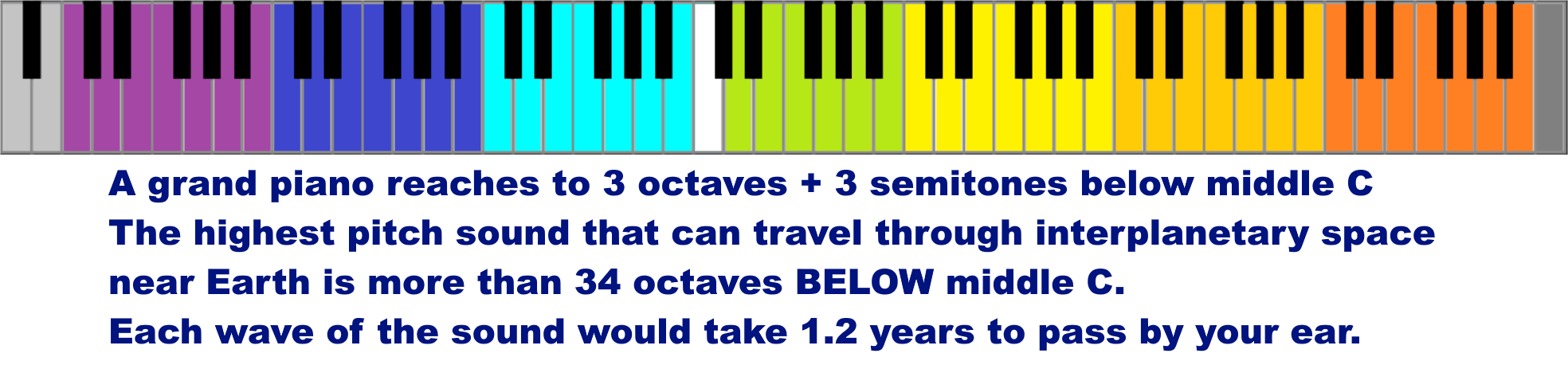
TEXT ON GRAPHIC
A grand piano reaches to 3 octaves + 3 semitones below middle C
The highest pitch sound that can travel through interplanetary space near Earth is more than 34 octaves BELOW middle C.
Each wave of the sound would take 1.2 years to pass by your ear."
Keyboard colouring from:
https://commons.wikimedia.org/wiki/File:88-key_piano_colored_octaves.svg
This is a Stacktrace answer with similar answer for Earth’s atmosphere
https://physics.stackexchange.com/questions/23418/is-there-an-upper-frequency-limit-to-ultrasound
As for Loeb, nobody takes him seriously it is just a comet. I don’t think even he takes himself seriously, though he clearly likes the media attention.
And likely once the Vera Rubin telescope comes online we will find one or two extraterrestrial comets or asteroids every month.
They are passing by all the time. We expect to see 1 or 2 a month.
The reason we didn’t see them before is that we only recently got the ability to see them because of software unblurring fast moving comets in images.
It makes no sense that the first visit by aliens would coincide with the first year since humans evolved that we have been able to see an interstellar comet or asteroid.
That is what Loeb said in 2017 about Oumuamua.
BLOG: Did a solar sail from an extra terrestrial civilization fly past us last year
— is that what Oumuamua is? Just a rather far fetched but entertaining article in Scientific American by Harvard researchers
You can read it here:
https://debunkingdoomsday.quora.com/Did-a-solar-sail-from-an-extra-terrestrial-civilization-fly-past-us-last-year-is-that-what-Oumuamua-is-Just-a-rather
The third one, same thing:
https://robertinventor.substack.com/p/not-remotely-plausible-that-3i-atlas
And it looks exactly like you’d expect an interstellar comet to look bearing in mind the huge variation of comet characteristics and that it’s interstellar so it has likely a slightly different composition coming from another star