My answer from here, should make into a new blog post some time:
https://ddebunked.org/d/3423-why-are-you-so-optimistic-about-climate-change/12
Steel and cement net zero by 2050
BLOG: IPCC: steel and cement industries can both be carbon zero
— unavoidable CO2 emissions with current technology
— but we can capture it at source
— already being done
You can read it here:
https://debunkingdoomsday.quora.com/IPCC-steel-and-cement-industries-can-both-be-carbon-zero-unavoidable-CO2-emissions-with-current-technology-but-we-c
Aviation net zero by 2050
BLOG: Rising to the challenge of zero emissions aviation
You can read it here:
https://debunkingdoomsday.quora.com/Rising-to-the-challenge-of-zero-emissions-aviation
Shipping - net zero emissions from shipping by 2050
https://www.imo.org/en/mediacentre/pressbriefings/pages/imo-approves-netzero-regulations.aspx
(not in my debunks)
Plastics - most challenging - but EU targets net zero plastics by 2050 too
The biggest challenge is plastics. In the AR6 report the IPCC concluded that it’s probably impossible to get it to net zero. Instead it would need to be offset as part of the small fraction of current emissions that need to be offset by land use change, land use and forestry (LUCLUF)
https://unfccc.int/topics/land-use/workstreams/land-use--land-use-change-and-forestry-lulucf
But now it seems we can.
Even there the EU now has a net zero road map for plastics, net zero by 2050,
Here is how they plan to do it.
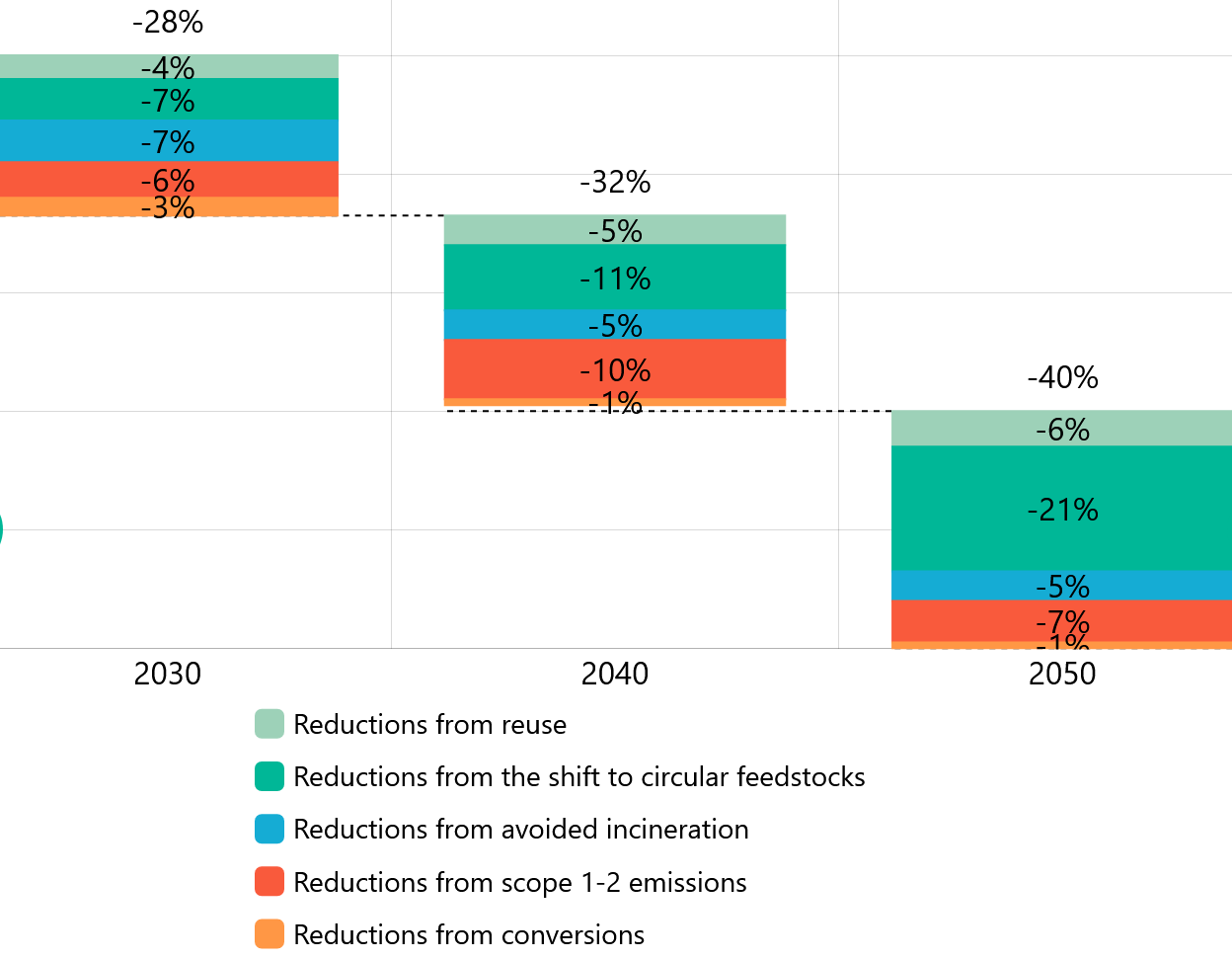
Making plastics circular
Plastics producers are developing new approaches relating to the reuse of products, product design, and business models. These approaches include fostering circular business models, further developing mechanical and chemical recycling, and expanding plastic production from biomass and captured carbon. To enable this, circular feedstock must be made available, and the demand and investments for circular solutions must be incentivised.
Making the plastics life cycle net-zero
To successfully pursue the net-zero greenhouse gas (GHG) target, levers include increased energy efficiency, the availability of low-carbon fuels, production using low-carbon electricity, and carbon capture & storage. This will require access to low-carbon energy, establishing a level playing field with global competitors, reducing GHG emissions in plastic conversion, and less incineration of plastic waste.
Fostering sustainable use of plastics
Producing and using plastic applications in a way that is safe for human health and the environment is key. Members of Plastics Europe are continually developing new actions, tools, and methodologies to comply with legal obligations and to foster safety and sustainability. They include partnering with value chain partners, safely managing additives, eliminating pellet loss during production, and collaborating to overcome knowledge gaps and prevent leakage.
https://plasticseurope.org/changingplasticsforgood/the-plastics-transition/
Ocean Cleanup could clean the Great Pacific Garbage Patch for $4 billion, cost of 2 - 4 days of the Iran war
On recycling plastics, there’s also Ocean Cleanup which is actively removing plastics from rivers and oceans
BLOG:
#PositiveNews: Ocean Cleanup removed 100 metric tons of plastics from the Great Pacific Garbage Patch in 2021–2
— larger net should remove a million metric tons in 2023
— ten large nets should remove a fifth of the patch every year
You can read it here:
https://debunkingdoomsday.quora.com/PositiveNews-Ocean-Cleanup-removed-100-metric-tons-of-plastics-from-the-Great-Pacific-Garbage-Patch-in-2021-2-larger
They have now got to the point where they could remove the Great Pacific Garbage Patch in 10 years for $7.5 billion with their current level of performance.
They believe they can get it down to 5 years and $4 billion.
QUOTE STARTS
Ocean plastic pollution is one of the most urgent problems our oceans face today, costing the world up to $2.5 trillion per year in damage to economies, industries, and the environment
The Ocean Cleanup’s operations demonstrate that the elimination of the GPGP can be done at today’s level of performance in 10 years at a cost of $7.5bn. Although, data and modelling indicate that the removal of the GPGP could be achieved in 5 years at a cost of $4bn
https://theoceancleanup.com/updates/the-great-pacific-garbage-patch-can-be-cleaned-for-7-5-billion/
They have paused operations for a year to do data mapping to find out where the plastic concentrates to make it easier to extract more of it more quickly.
QUOTE
In 2025, The Ocean Cleanup’s extraction operations will be on hiatus for one year in order to deploy a new hotspot hunting initiative designed to map the “hotspots,” or areas of intense plastic accumulation in the GPGP, making extractions more impactful.
https://theoceancleanup.com/updates/the-great-pacific-garbage-patch-can-be-cleaned-for-7-5-billion/
Meanwhile they also diversified to clean up rivers as well, also coastlines to stop it getting into oceans also waste management now as well.
https://theoceancleanup.com/projects/
That $4 billion is the amount the US spent on the Iran war in 2 to 4 days.
AI uses a small amount of energy and rapidly getting more efficient
The energy used by AI is small and it is rapidly getting far efficient, a ten fold reduction.
The AI bubble is not going to burst. That is because unlike the dot com bubble it is financed by companies with deep pockets. They don’t need to make a profit on it for a decade or for ever and can pay for it just with the cash in hand. But in reality it is rapidly costing less and using less energy.
What they miss is that chatbots are getting more and more energy efficient. Ten fold reduction in energy use in 2 years and continues to go down. Both through much more energy efficient chips and huge improvements in how the models work - can do much more with simpler models.
Details here:
https://ddebunked.org/d/3028-ai-energy-usage-and-climate-footprint/2
And about how most of the companies that invested in AI are doing it from huge funds - not borrowing money from their own cash reserves. You can’t even invest in Bing Copilot, say, if you wanted to. Only indirectly in Microsoft.
And many are losing money but can afford to keep doing so indefinitely. The big ones like Google, Apple, Facebook, Microsoft etc. Even if they never earn anything from AI and lose money every year they can keep going but in reality the cost of AI is going down rapidly and its fast moving into profit making territory.
https://ddebunked.org/d/999-ai-has-be-worrying-about-the-future/5
May well be things we can’t reduce to net zero - but then we have Land Use Change, Land Use and Forestry - and after 2050 many other ways to offset - some pay for themselves
There may well still be things we can’t reduce to zero. But that is not the aim to have net zero for everything. Instead we need to take up a few % of current emissions by land use change, forestry, mangrove swamps etc.
Then in the second half of this century there’s some possibility that those land sinks saturate - they are no longer able to absorb so much per year. If so there are NUMEROUS other ways of removing CO2 and many of them pay for themselves. Including soil improvement, we could remove CO2 from the atmosphere, to boost the fertility of soils globally
We can do that with biochar for instance. That is a way of putting lots of charcoal into the soil by controlled slow charring of agricultural wastes - it’s a method used in the Amazon in ancient times to make very thick, rich soils.
Another is to do farming in the sea with giant kelp which also at he same time reverses acidification of the oceans. Another is burning / using agricultural waste in a biorefinery. And if we do have to pay for it then one of the lowest cost ways is to spread ground alkaline rock on beaches or in the sea which reverses acidification again and takes CO2 from the atmosphere.
There are many other ways of doing it, including carbon-negative cement production for instance. I go into it here:
https://robertinventor.substack.com/p/dare-to-hope-climate-restoration
As we approach net zero, warming reduces from 0.2 C per decade to 0.1 C per century - far easier for nature to adjust with 500 years from 1.5 to 2 C, say
Then something many don’t realize. As we get closer to net zero then the warming is slower and slower. It’s currently 0.2 C per decade. With the triple renewables pledge we should halve emissions some time in the 2030s. Then it’s 0.1 C per decade.
By going net zero wherever we can then we get down to maybe 5% of current emissions or a hundredth of a degree per decade. Or a tenth of a degree per century.
That is still not net zero. But it is far easier for nature to adjust to a rise of a tenth of a degree per century than a fifth of a degree per decade.
Then - we need to avoid reaching close to 3 C. At that point we risk losing the corals because of CO2 dissolved in the oceans reducing the alkilinity, not the temperature (a warmer world is more habitable for corals)
Might decide we want a slightly warmer world and can turn thermostat up or down by tenths of a degree as desired
But suppose we get to 1.5 C by 2050 and we are increasing by 0.1 C every century. Then it would take 500 years to reach 2 C. We might even decide we would like a slightly warmer world if warming that slowly.
BLOG: The warming of the Anthropocene has benefited the world in many ways
— the issue is the speed of change and we likely wouldn’t want to go rapidly back to preindustrial from 1.8 C
You can read it here:
https://debunkingdoomsday.quora.com/The-warming-of-the-anthropocene-has-benefited-the-world-in-many-ways-the-issue-is-the-speed-of-change-and-we-likely-wo
And at that point we can likely do many things to turn the thermostat up / down and would likely be lots of debate about whether we want to stay at the same temperature, get warmer or cooler., All options would lead to a mix of pluses and minuses.
https://ddebunked.org/d/3423-why-are-you-so-optimistic-about-climate-change/10
And all this IS taking account of weaker economies improving their standard of living. For instance net zero aviation is based on increasing numbers of flights every year.
Net zero steel, cement, aviation etc is scaleable so that as weaker economies industrialize they are still net zero - cement can even be net negative
Once you have net zero steel and cement then it doesn’t matter how much you are making, it is still net zero. Indeed cement can even be net negative so that the more of it you have the more CO2 you remove.
https://ddebunked.org/d/3423-why-are-you-so-optimistic-about-climate-change/11
The IPCC AR6 WG III report goes into this in great detail. Very few seem to have read it. And we have moved beyond it’s conclusions now in many respects.
This for example is based on AR6 WG III Chapters 7 and 12.
BLOG: Dare to Hope
— Climate Restoration
— Three ways to get CO2 levels back to pre-industrial 300 ppm by 2050
— potentially pay for themselves
— many more ways to remove CO2 in IPCC AR6 / WIII Ch. 7 & 12
You can read it here:
https://robertinventor.substack.com/p/dare-to-hope-climate-restoration
Most climate activists haven’t ready AR6 / WG II chapters 7 and 12 on net zero after 2050
Hardly anyone seems to have read those chapters and they go on and on about having to remove CO2 from the atmosphere with machines that don’t exist yet.
The IPCC never assumed we do that. The MODELERS assume removing CO2 using direct air removal simply because there are so many other ways to do it but if they assume another method they have to make assumptions specific to that method - while the direct air capture has minimal assumptions. So they do it for ease of modelling and to make the models as widely applicable as possible.
I doubt if as many as 1 in 10 of climate activists know that. Which shows they never did more than briefly glance at AR6 WG III and never for instance read the chapter headings.
It’s not surprising. The reports are long and technical. Most probably assume that the mainstream media covered them adequately and never read them. But do bear in mind that there is a huge amount of criticism of the IPCC out there by people who have barely more than glanced at their reports and likely never got as far as reading the chapter headings.
Ahead of the curve on triple renewables pledge, one way to within 1.5 C
We are ahead of the curve for the triple renewables pledge, one way to stay within 1.5 C.
BLOG: We are ahead of target for 1.5 C with the COP28 triple renewables pledge
— media and academics lag far behind what’s happening in the real world when they claim we are headed for 2.6 C
You can read it here:
https://robertinventor.substack.com/p/world-is-overachieving-for-15-c-with
There is lots of action on climate change. I go into the triple renewables pledge in more detail here as well as many other things.
https://ddebunked.org/d/3128-helloooooo/2
We can all help
And we can all help.
There are many things you can do by way of lifestyle choices to help with climate change. It’s about looking for things you find easiest to do not hardest to do. Those are the low hanging fruits and things that others are likely to join in with.
BLOG: 12 Simple lifestyle changes to help reduce global warming and biodiversity loss
You can read it here:
https://debunkingdoomsday.quora.com/12-Simple-lifestyle-changes-to-help-reduce-global-warming-and-biodiversity-loss
My blog post here may help also
BLOG: Videos of good things that are happening in the world for climate change and biodiversity
You can read it here: https://debunkingdoomsday.quora.com/Videos-of-good-things-that-are-happening-in-the-world-for-climate-change-and-biodiversity
Why we see so much that’s negative when in reality there’s a lot positive going on.
https://ddebunked.org/d/82-why-news-outlets-twist-the-headlines-to-make-things-around-the-world-sound-a-lot-scarier-than-they-should-be
BLOG: How to motivate your self, and others to act on climate change, biodiversity or anything else
— tips from psychology
— e.g. for maximum engagement present 3 positive or supporting framings for each climate threat
You can read it here:
https://debunkingdoomsday.quora.com/How-to-motivate-your-self-and-others-to-act-on-climate-change-biodiversity-or-anything-else-tips-from-psychology