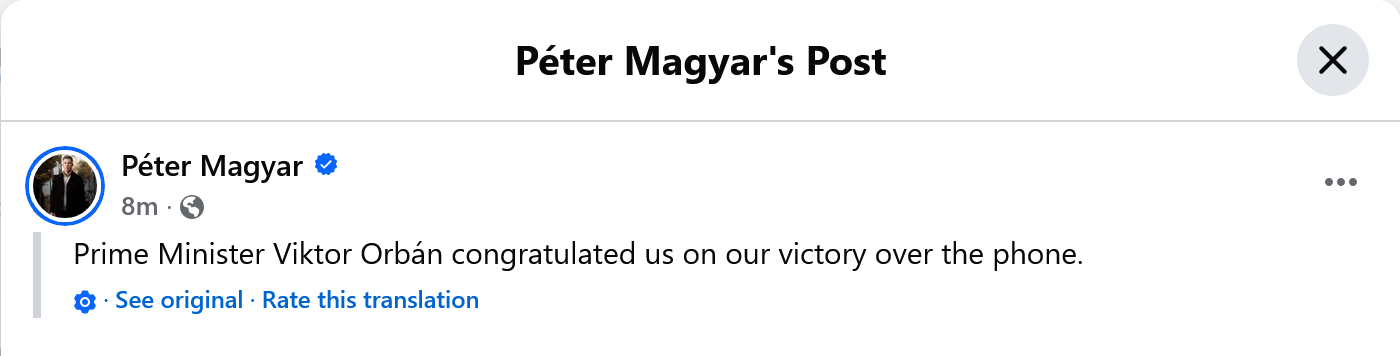
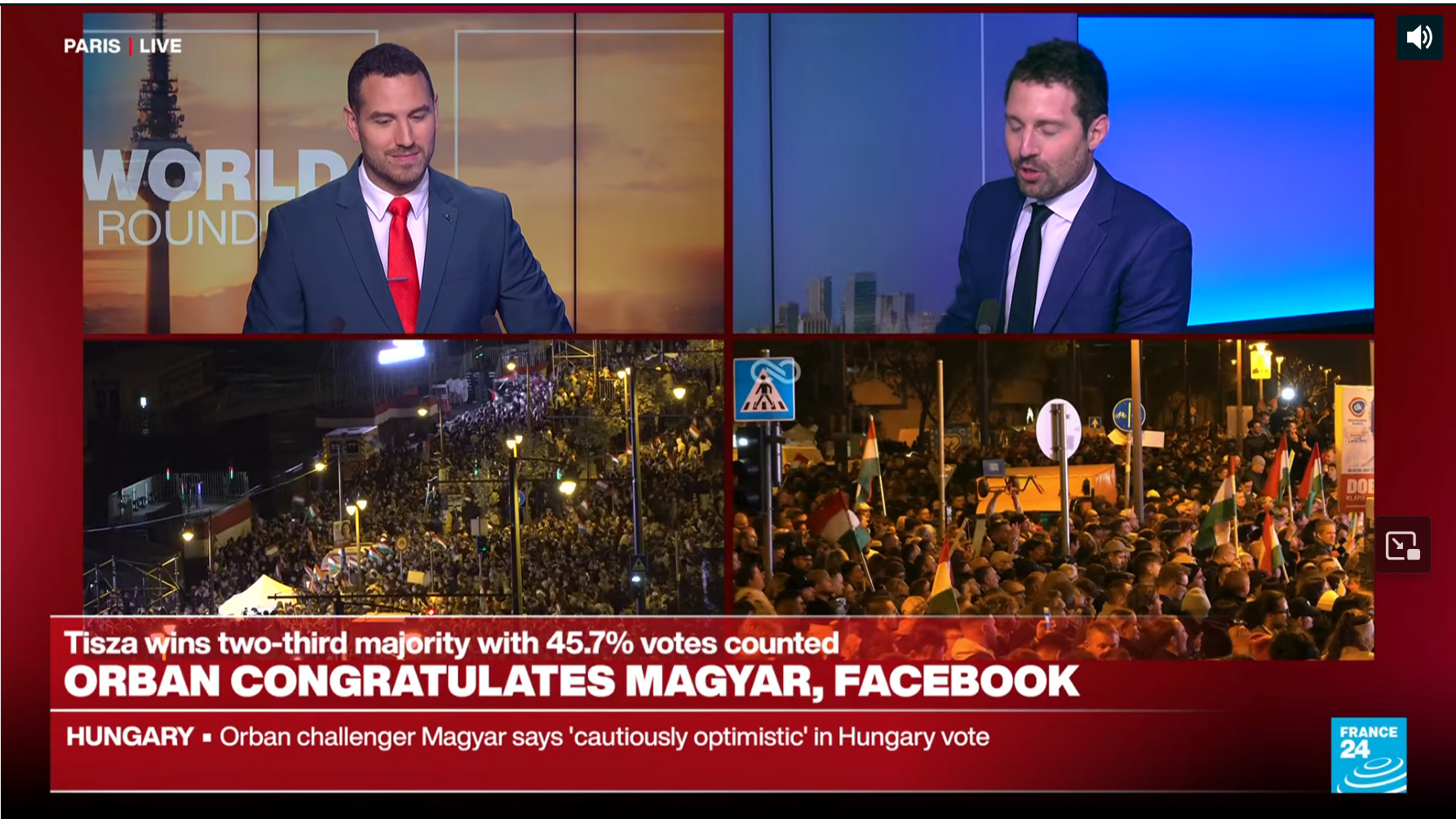
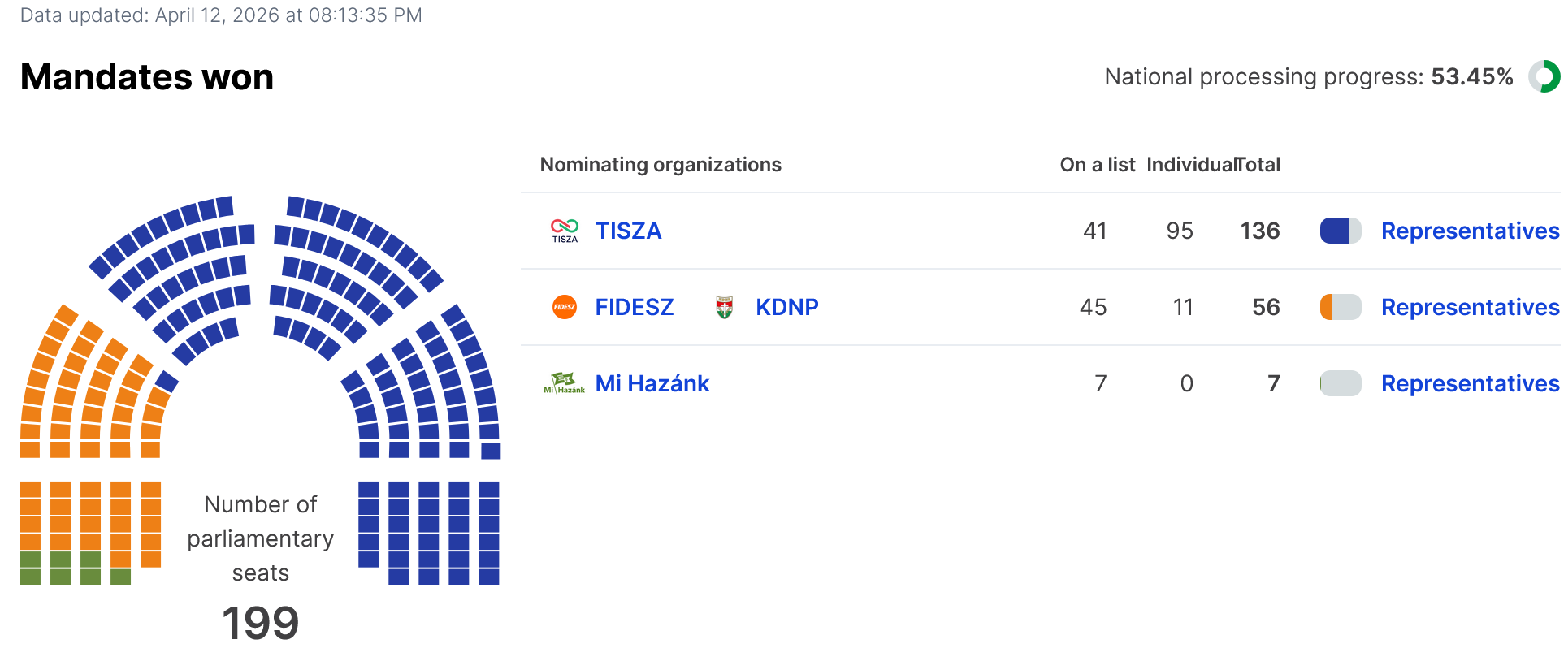
Victor Orban conceded to Peter Magyar with a very clear majority. The final total is 141 seats for Tisza by the end of count on Saturday at 100% complete. It’s 133 for a ⅔ majority.
This means that Peter Magyar can
- undo the constitution changes by Orban
- dismiss the justices etc put in place by Orban
- reverse the “cardinal laws” that need a ⅔ majority to change them.
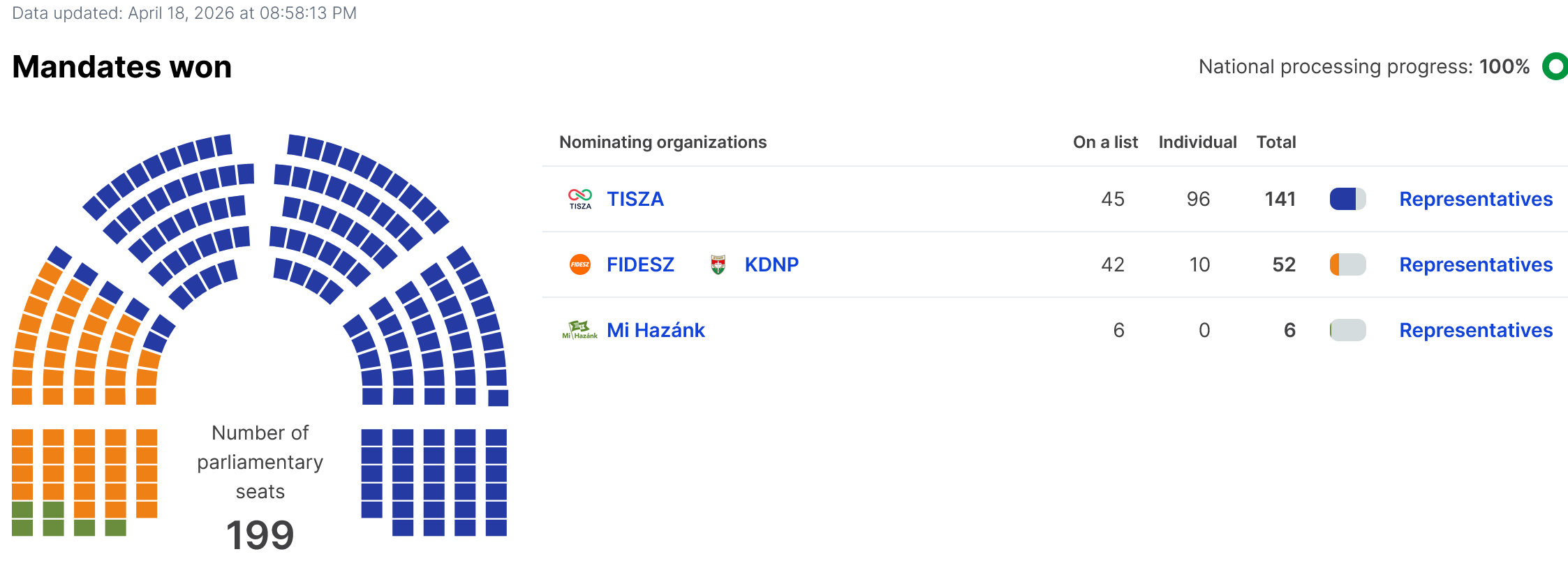
https://vtr.valasztas.hu/ogy2026?filter=orszagos
Associated Press, (and others like BBC) say it’s the younger voters that especially won the election for Peter Magyar.
TWEET
💥🇭🇺🗳️ WOW! 54.14% turnout by 1pm in Hungary’s historic election (vs 40.01% in 2022), where voters could end Viktor Orbán’s 16-year rule. Massive participation, in line with independent pollsters’ predictions – who also predicted a massive opposition win. Polls close at 7pm.
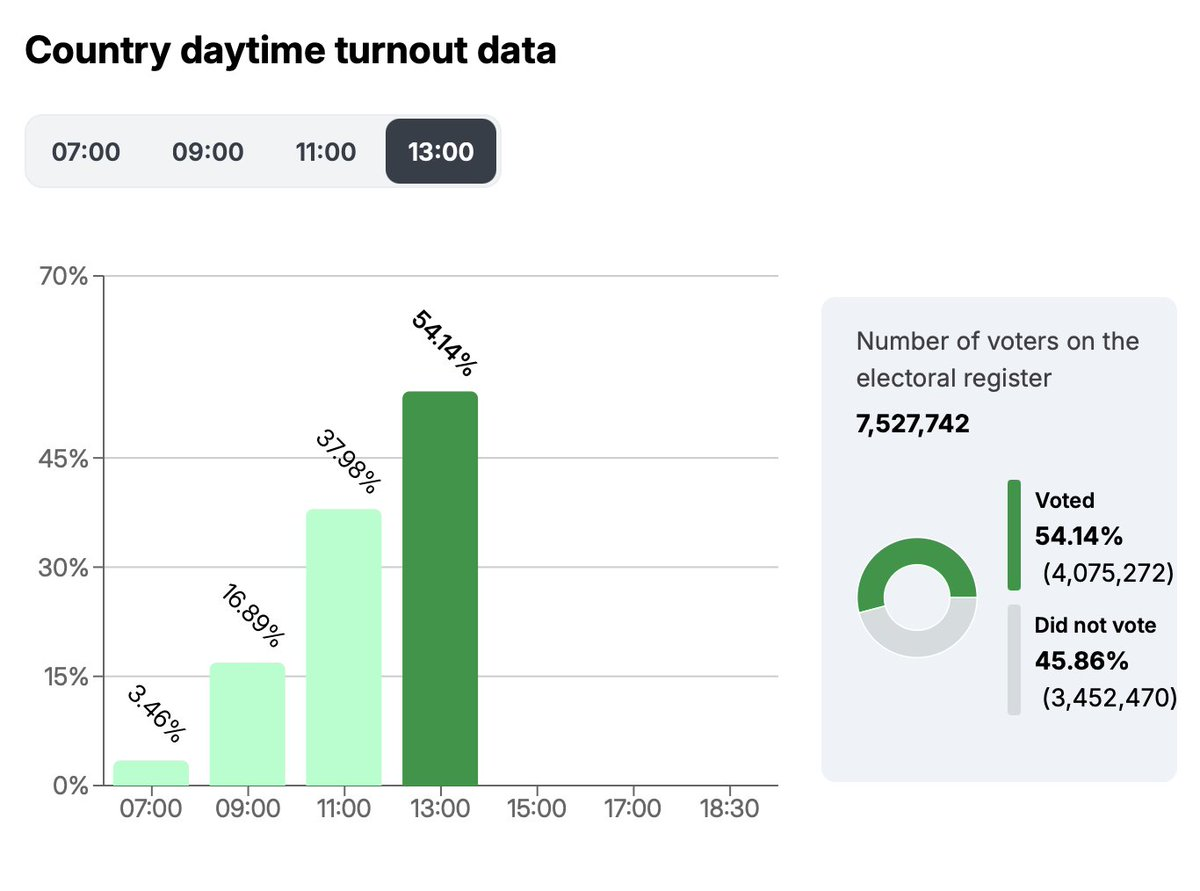
This was retweeted by Szabolcs Panyi, a Hungarian journalist who I follow.
https://x.com/panyiszabolcs
Victor Orban also did a Facebook post urging his followers to turn out to vote because a lot of people are voting - mistranslated by Facebook as “too many people are voting”
Auto translate
Orban: A lot of people are voting.
This means one thing: if we want to protect the security of Hungary, no patriot can stay home!
Only Fidesz!
Up, to victory!
But it’s unlikely that a big turnout would be due to Fidesz voters.
Politpro suggests a small majority for Hungary of 104, only 100 needed for majority - but the elections are very sensitive and can shift a large amount either direction and are hard to predict because Tisza never had candidates before.
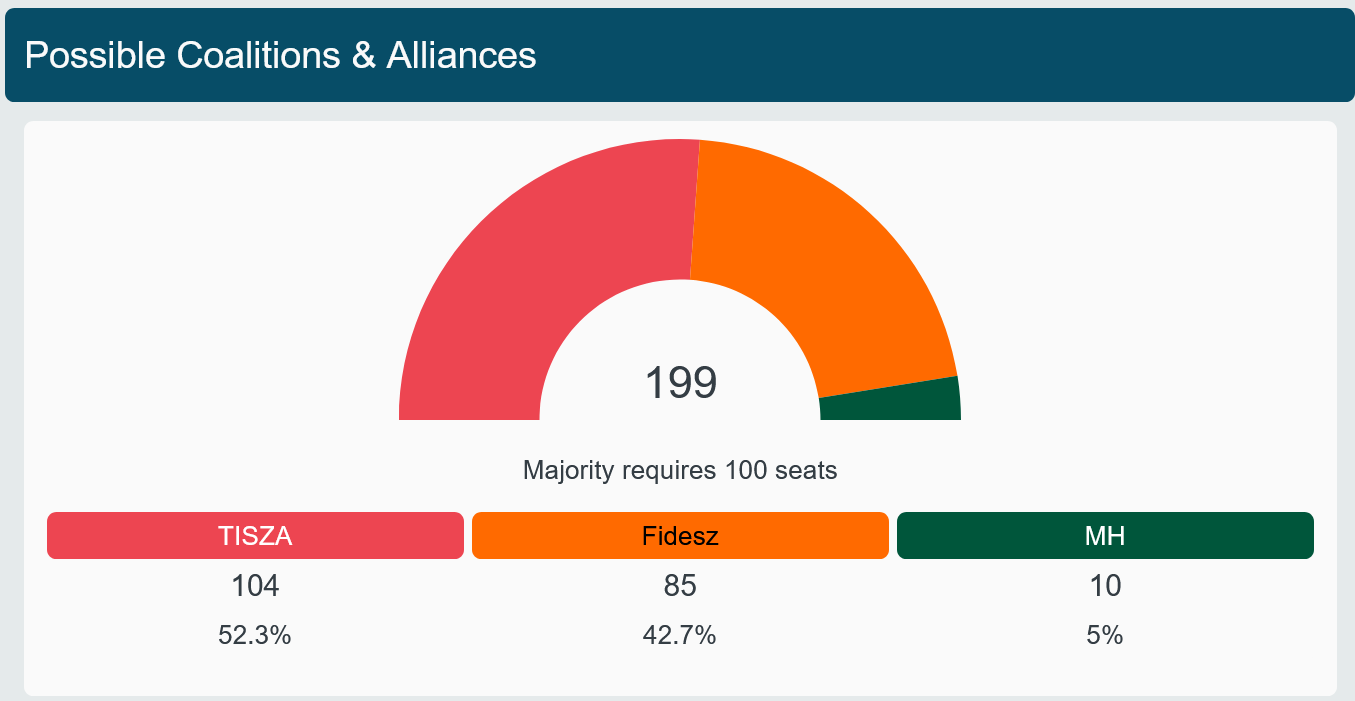
https://politpro.eu/en/hungary
It’s very hard to predict but there’s a significant potential to win. JD Vance is not likely to have improved his chances, and I think quite possibly wasn’t even trying to.
https://ddebunked.org/d/3522-hungary-us-dispatches-jd-vance-to-aid-orban-reelection-bid/5
There’s a huge level of uncertainty.
They are free but not fair elections.
- NOT FAIR: Orban has control of the media and publicity.
- countering that, nowadays a lot of the campaigning is via social media, and he can’t control that.
The voting itself is FREE
- the votes won’t be interfered with, no vote stuffing etc like you get in Russia.
Very hard to predict because the polls are unreliable, all the polls are low to medium quality and often biased.
Politpro predicts 104 so a small majority for Tisza, majority is 100.
https://politpro.eu/en/hungary
However Tisza didn’t run for the last election. There’s a lot of uncertainty for instance they don’t know the distribution of Tisza voters in rural areas and there are many small first past the post constituencies.
Then there’s an unusual provision - that if the first past the post leads to many more votes than are needed to win - then the winning party gets to use all those extra votes for the proportional representation part of the seat count.
So for instance if Tisza or Fedesz won a seat by say 10,000 to 1,000 as the second largest vote share, they get one short of 9,000 votes to add to the national count for proportional representation.
This normally favours Fidesz but it could also lead to a massive swing to Tisza if they win lots of the local constituencies by large margins.
All this means that 104 seats is more of a rough guess than a prediction and it could easily be a massive majority for either party. If Magyar’s Tisza wins ⅔ of the seats they can then edit the Hungarian Constitution without support of any other party. That would be surprising but not impossible. That is how Fidesz was able to do it.
Here is a more detailed breakdown of the possibilities.
Simple Majority for Tisza
Among the possible seat projections for this election, the first scenario indicated by independent polling is that Tisza secures a simple majority but falls short of the two-thirds supermajority.
According to the election forecasting website Választási Monitor, which aggregates both government-aligned and independent polling data, the average of independent polls suggests that Tisza could win approximately 112 seats (56.3 percent), a majority but not the two-thirds threshold.
…
A Low-Probability but Possible Deadlock
Although less likely, Hungary’s electoral system could theoretically produce a scenario in which neither major party secures a majority. In that case, the far-right Mi Hazánk could become a pivotal third party if it surpasses the 5 percent threshold.
However, cooperation with Mi Hazánk would be politically difficult for either major party. Although Fidesz has sent signals toward potential cooperation, Mi Hazánk itself denies such intentions. For Tisza, cooperation with a far-right party would likely provoke strong voter backlash. At the Szentendre rally mentioned earlier, when Magyar referenced the possibility of a “Fidesz–Mi Hazánk coalition,” the audience reacted with clear opposition. This scenario would likely result in political stagnation.
The High Bar of a Two-Thirds Majority
Although the most likely projection remains that Tisza could win a majority but fall short of a two-thirds supermajority, the party is aiming to secure such a supermajority.
Party leader Péter Magyar has repeatedly emphasized to supporters that victory should not be narrow but decisive. “We will win the election. Not narrowly, but by a large margin. Our goal is to secure two-thirds of the seats,” he emphasized at a rally in April 2025.
Even if independent polls show Tisza ahead, however, achieving a two-thirds majority remains more difficult for Tisza than for Fidesz. For example, 21 Kutatóközpont conducted a simulation using the latest district boundaries and incorporating factors such as alleged vote buying by Fidesz and the high name recognition of long-serving Fidesz candidates.
According to this simulation, if polling results showing Tisza leading by 19 percentage points are realized, Tisza could win 88 district seats and 46 proportional seats, totaling 134 seats (67.34 percent). However, even a slight decline in Tisza’s support or a modest increase in Fidesz’s support could prevent Tisza from reaching that threshold.
Could Fidesz secure a two-thirds majority? According to the latest seat projection from the Nézőpont Institute, Fidesz is expected to win 66 single-member districts. If that estimate proves accurate, securing 34 of the 93 proportional seats would be sufficient for a majority, and depending on the proportional vote share, achieving two-thirds would theoretically not be impossible.
Nevertheless, even for Fidesz, achieving a two-thirds majority appears extremely difficult. In the Nézőpont Institute’s latest projection published on April 3, Fidesz is expected to win 66 district seats and 43 proportional seats, totaling 109 seats, far short of the 133 seats required for two-thirds. Similarly, Választási Monitor’s aggregation of government-aligned polls suggests that Fidesz could emerge as the largest party with 124 seats (62.3 percent)—again falling just short of the two-thirds threshold.
Why Two-Thirds Matters
Whether any party secures two-thirds of the seats will have decisive implications for post-election scenarios. As shown in Table 2, Hungary requires two-thirds parliamentary approval not only for constitutional amendments but also for many important laws and appointments to key national institutions.
https://instituteofgeoeconomics.org/en/research/2026040901/
So, you just can’t say. But the high turnout looks promising for Magyar
If Orban wins - continues as before - if Magyar wins - better for LGBT rights in Hungary, they get billions in EU funding - and less obstructive approach to EU aid to Ukraine though unlikely to directly contribute
If Orban wins it continues much as before. If Magyar wins it’s better for LGBT rights in Hungary and they unlock billions in EU funding and it is possible they have a less obstructive approach to aid to Ukraine with Magyar likely to be less strong in opposition to EU funding though probably not go as far as to fund Ukraine from Hungarian funds.
QUOTE STARTS
Magyar has made broad statements about shifting Hungary’s foreign policy away from Moscow and towards the EU and NATO.
He has avoided being too specific on Ukraine beyond indicating that he does not support moves to grant Ukraine accelerated EU membership. But analysts did expect a change of tone from Magyar if he wins.
“His campaign rhetoric on Ukraine has been muted, has been very restrained. He does not dare to just openly confront Viktor Orban on this question,” Dalibor Rohac, senior fellow at the American Enterprise Institute, told RFE/RL.
“But the postelection reality in which Peter Magyar will have to repair Hungary’s relationship with the EU and Hungary’s allies and restore Hungary’s place in Europe…will make it inevitable that Hungary will become a more constructive partner, including for Ukraine,” he added.
Vegh voiced a similar view.
“The attitude and the approach generally would be different. I think there would be an attempt for partnership towards the EU’s policies regarding Ukraine,” she said.
In his RFE/RL interview, Magyar also praised Trump for his Gaza peace initiative and for putting pressure on Russia to agree to “peace, or at least a cease-fire” in Ukraine.
When JD Vance visited Budapest on April 7, the vice president also stated the White House’s support for Orban, but added that the United States would “work with whoever wins this election.”
https://www.rferl.org/a/hungary-election-orban-magyar-opposition/33729297.html