My first attempt at a debunk post here. I wanted to provide some context for the local election results, as there’s a lot of extreme takes that may scare people, the primary one being “reform got significant net gains again so they’re going to win the next general election”
Remember that the local council election system is quite messy (some councils elect in thirds, mayoral elections on different cycles, different electoral systems, etc). Additionally local elections also have much lower turnout compared to general elections (30-35% vs 60-70%), and often amplify non-incumbent parties. However, we can still use the local election results as a rough guide to what the national picture currently look like by looking beyond raw seat numbers.
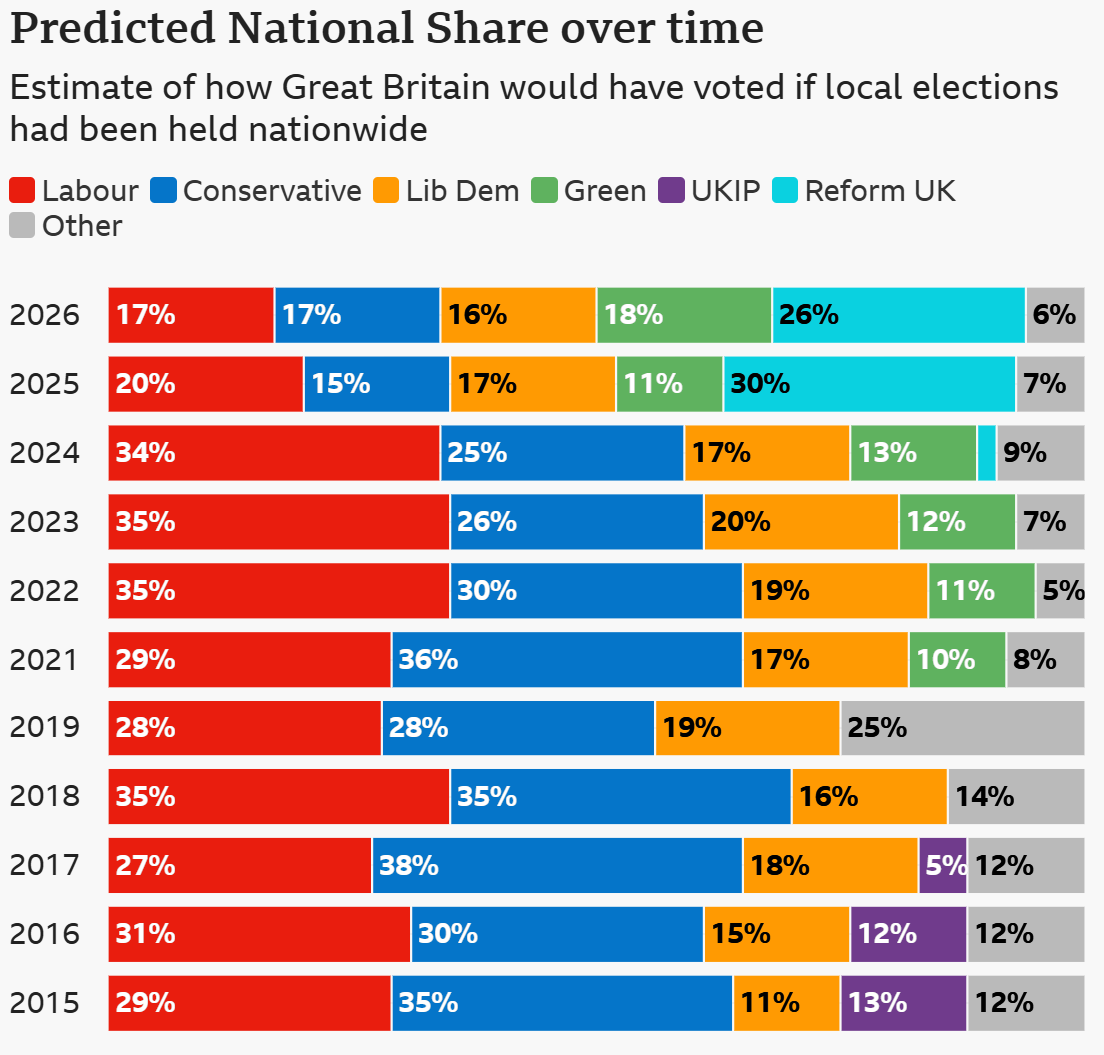
The Projected National Share (PNS) this year shows more equal spread in vote share between 5 parties compared to 2025 - in particular that reform has peaked and greens are mainstream
The Projected National Share (PNS) estimates the national share in vote for each party based on local election results. The PNS value calculates this by taking the results of the local elections and then estimating what the GB share of the vote would have been if local elections were held everywhere, and the principal parties contested all the seats.
This gives us a statistic we can use to compare performance in local election years, irrespective of the places that are holding them each year. It’s the best statistic we can use to extrapolate the results of the local election to a national picture
An important note here is that whilst the PNS is expressed as a GB share of the vote, it is based entirely on local election results in England and doesn’t account for the Welsh and Scottish parliament results. So it’s best seen as an indicator of political developments in England.
This Elections Etc article written in part by John Curtice explains the PNS in detail:
https://electionsetc.com/2026/05/07/understanding-the-local-elections-projected-national-share-pns-in-2026/#more-2941
With our understanding of what the PNS is, we can now compare the PNS recently released for this years local election compared to previous years.
SOURCE: https://www.bbc.co.uk/news/articles/c0ljrp76ywxo
What do these results tell us?
The voting between the five parties has become a lot more evenly spread. Whilst Reform is still the outlier in percentage points and in front by a decent margin, they have peaked with a -4% change in PNS, as has been reflected in polling for a few months. In contrast, the PNS of the green party has risen by 7% to 18%, sitting a percentage point above Labour and the Conservatives, and two above Lib Dems - showing that the Greens have managed to become a mainstream voting option.
Even using councillor gains, Reform underperformed significantly compared to last year.
Reform has a net gain of +1453 seats in this years local election.
Despite continuing to benefit from their surge last year, reform have slipped in their performance in local elections, primarily because their first performance was so positive. Pre election, Stephen Fisher (Associate Professor in political sociology) set a benchmark of +2050 net seat gains to show they are still performing as well as last year, and +1935 to be on par with recent local election results. Reform did not meet either target.
https://electionsetc.com/2026/03/20/benchmarks-for-reform-seat-gains-at-the-2026-english-local-elections/
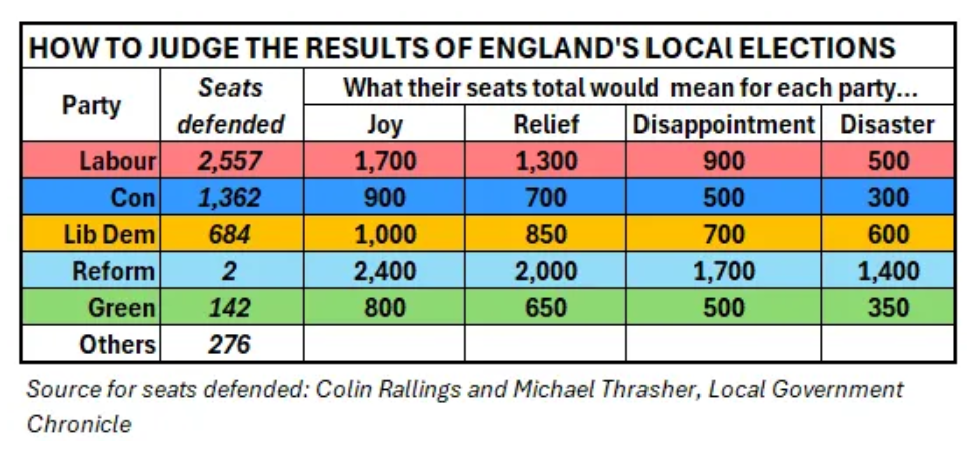
Peter Kellner, political commentator and former president of YouGov UK, also suggested some ‘yardsticks’ pre-election for judging each party based on polling projections. He does note here that the figures are subject to wide margins of error.
SOURCE: https://kellnerp.substack.com/p/how-to-judge-next-weeks-election
When now looking at the percentage of seats won in this years local elections, Kellner writes
“Behind the impressive tally of Reform’s gains – likely to end up well over 1,000 – Nigel Farage should be privately worried. In last year’s local elections Reform won 41 per cent of all seats contested across England. On the basis of the overnight figures, this year’s tally is around 33 per cent [later found to be 30%]. If there were no polls, and there had been no elections last year, this year’s figure would be astonishing. But we do have the record of recent polls and elections, and it seems clear that Reform has peaked.”
https://kellnerp.substack.com/p/yesterdays-elections-the-story-so
A party losing seats to reform does not always mean a party is losing votes to reform
To take an example with the Labour party - Persuasion UK (a research initiative studying public opinion) conducted research on Labour’s left defectors, known as ‘progressive defectors’ in battleground constituencies. These are people who voted labour in 2024 who have now switched or are considering switching to other left-wing parties. The survey found that the percent of left defectors greatly outnumbers the percent of right defectors.
https://persuasionuk.org/research/revolt-on-the-left
According to Kellner, This was echoed by John Curtice on BBC news early on in the election. Labour has lost many SEATS to Reform, it has lost VOTES more to the Greens.
https://kellnerp.substack.com/p/yesterdays-elections-the-story-so
I’ve been trying to look for a quote from Curtice regarding this. The best I can find was from a facebook post by the Daily Politik
It should be remembered that labour may often lose seats to reform because it is losing votes to the greens, while the conservatives are losing votes to reform. The net effect can be that labour end up losing a seat to reform
https://www.facebook.com/TheDailyPolitik/posts/professor-john-curtice-says-that-voting-shows-the-green-party-are-doing-more-dam/1459855242853104/
I’m going to wrap this up as I’m running out of steam hahah. But yeah, hope this was helpful for those worrying or thinking about the local election results.
Further Reading:
https://www.politicshome.com/opinion/article/how-to-read-the-local-election-results