If we do get a super El Nino it’s nothing to worry about. Just a very strong El Nino. And that’s just warm water moving around. It’s better for harvests in some places (e.g. US mid west), worse in others and global yields were at record levels in recent El Ninos.
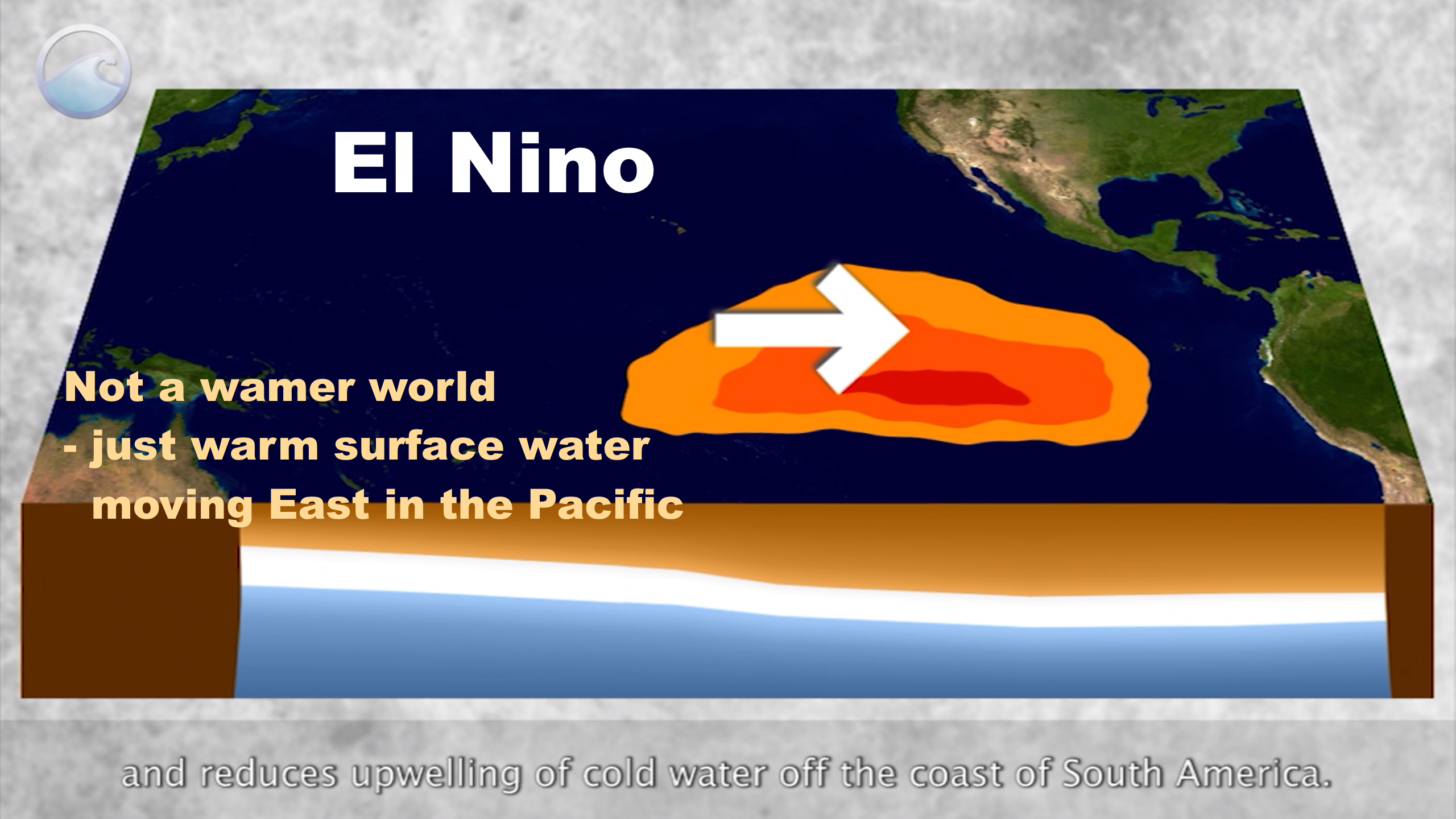
TEXT ON GRAPHIC
El Nino: Not a warmer world - just warm water moving East in the Pacific
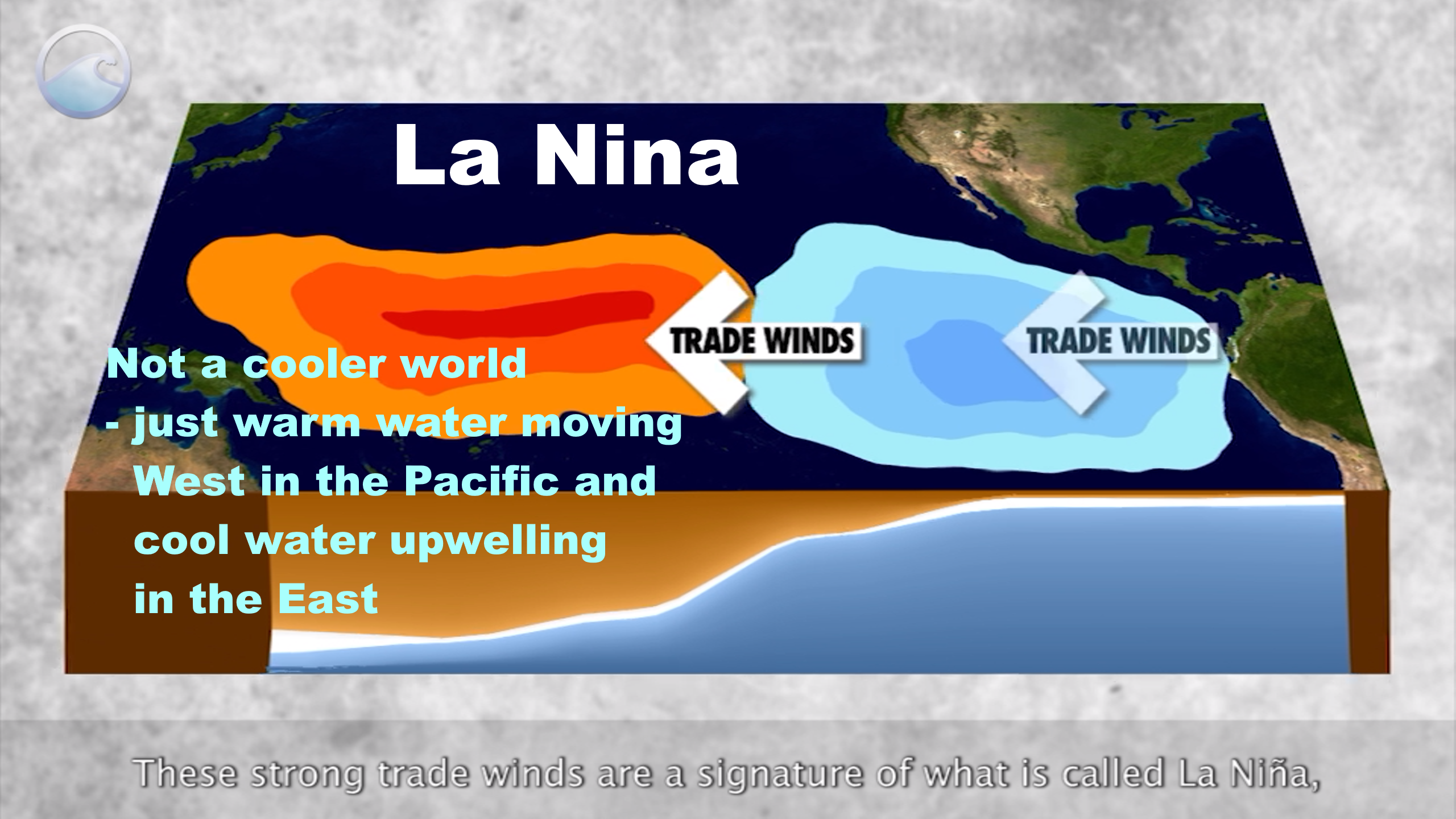
TEXT ON GRAPHIC
La Nina: Not a cooler world - just warm water moving West in the Pacific and cool water upwelling in the East.
This is the basic thing that almost nobody except experts on weather and a few geeks seem to know about El Nino and La Nina
El Ninos raise the MEASURED average temperature of Earth for just one year. But the world isn’t really getting warmer. It depends on how you measure it.
For the yearly temperature climate scientists use the average over the entire Earth measured:
- a meter or so above the land
- at the surface of the sea.
But what about all the heat in the air or in the ocean or the land itself? All that is ignored. Obviously you aren’t really measuring directly the heat in the Earth’s climate. Just in a thin shell where humans live. The heat is moving in and out of it all the time. A wind blows and it brings in some cold air and the ground gets colder and the air above it. And then a warm wind comes and it gets warmer. Varies night and day. Depending on whether its cloudy or sunny, raining, maybe a hail storm or snow or frost.
So why measure it in this eccentric way just in this shell where we live? Because that’s where it is easy for us to measure it, because that is where we live. We measure it this way for convenience, because it would be far harder if we tried to measure the temperature of the air, the clouds, deep sea currents, mountains, buildings, the ground below our feet down to many meters etc.
The El Nino raises this average but
- a lot of the warmer areas in an El Nino are over sea or they are in particular areas
- most of the world isn’t affected in temperature
- some parts get slightly cooler.
Those graphics are from here, from the US National Ocean Service video explaining what an El Nino and La NIna is
https://oceanservice.noaa.gov/facts/ninonina.html
So - it’s not global warming in the sense of climate change. To avoid being confused by temporary movements of heat in and out of the thin surface shell of the surface of the oceans and the air above the land where we live, the IPCC uses the temperature averaged over the entire oceans + just above the land over a period of usually 20 years before and after.
El Ninos have
- no effect on the Arctic ocean or Western Europe or Northern / central parts of Eurasia or most of Africa.
- Only a few places get warmer.
- Other places stay the same temperature but wetter or drier
- others get cooler.
- a lot of the warming is in the sea in the Pacific.
Day to day weather variation is far more than any of these changes.
During the recent El Ninos as a matter of record, we have had bumper harvests. They have mixed effects, benefit some areas and reduce yields in others.
BLOG: Yes 2023 is hottest year on record
— but just a short term +0.2 C on top of 1.2 C
— and the warm weather lead to the highest cereal harvest and highest end of year cereal surplus on record
— already adaptation is as important as reducing emissions
You can read it here:
https://debunkingdoomsday.quora.com/Yes-2023-is-hottest-year-on-record-but-just-a-short-term-0-2-C-on-top-of-1-2-C-and-the-warm-weather-lead-to-the-hig
It looks likely but not certain that we have a strong El Nino and a 1 in 4 chance of a super El Nino. From 19th April:
QUOTE
QUOTE STARTS
“After a period of neutral conditions at the start of the year, climate models are now strongly aligned, and there is high confidence in the onset of El Niño, followed by further intensification in the months that follow,” said Wilfran Moufouma Okia, Chief of Climate Prediction at WMO.
“Models indicate that this may be a strong event – but the so-called spring predictability barrier is a challenge for the certainty of forecasts at this time of year. Forecast confidence generally improves after April,” he says.
https://wmo.int/media/news/wmo-likelihood-increases-of-el-nino
We are getting to the point where we can have better forecasts now it’s May but I don’t see them yet. This is an expert saying confidence is shifting towards a super El Nino but not actually predicting it with a % probability
So what happens to agriculture? It’s a mixed picture, better for some, worse for others. Here is a prediction for the USA. El Ninos tend to bring more rain in a central belt in the USA where it’s welcome relief from drought. With drier conditions to East and West. And much of the country neither drier or wetter.
QUOTE STARTS
Ag meteorologist Brian Bledsoe of Brian Bledsoe Weather says the talk of a strong El Niño could be good news for the South and Plains, but the area of concern remains in the Pacific Northwest for summer and fall. And he expects El Niño to continue to be a story into 2027.
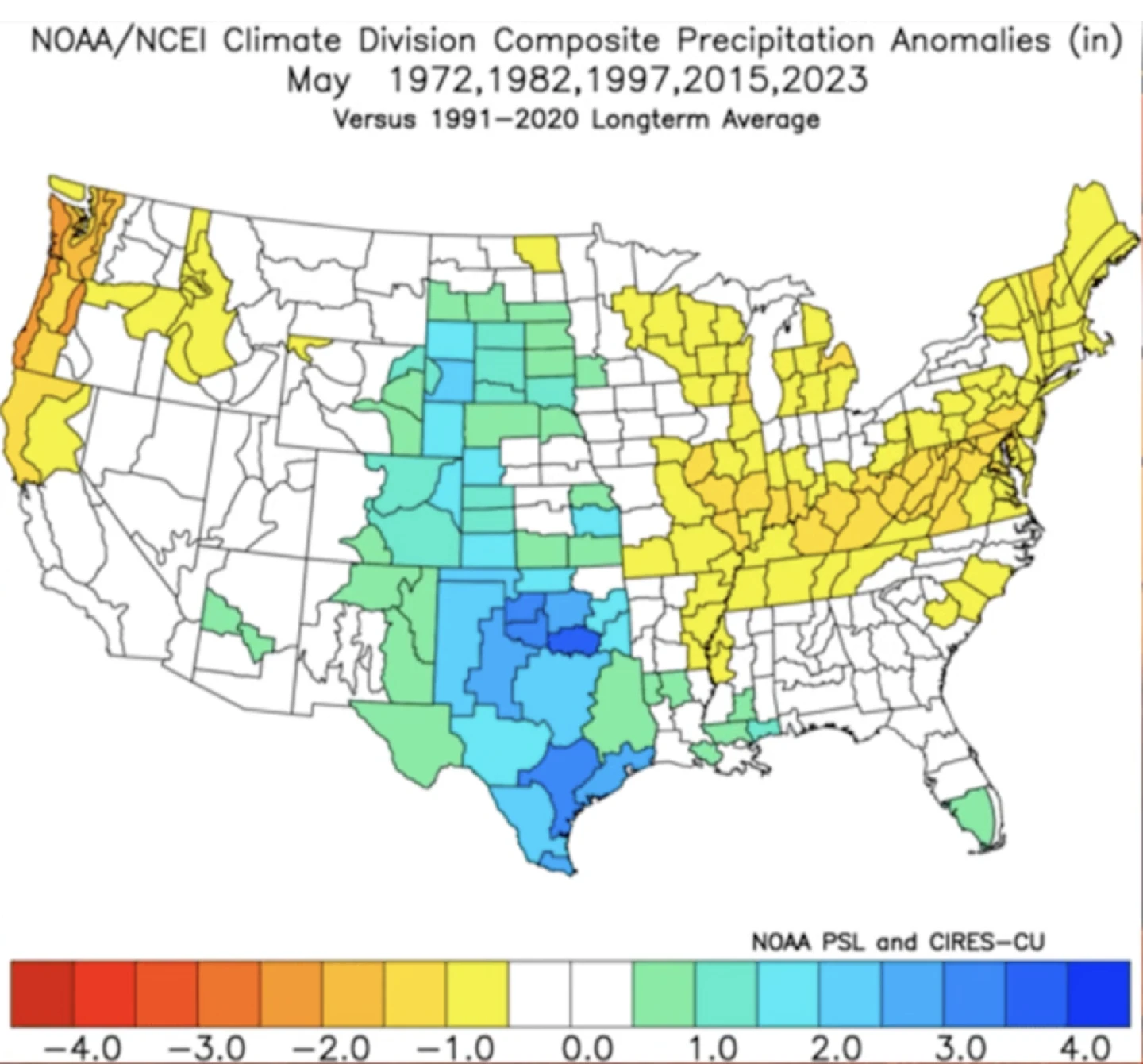
“If you look at what the Plains do traditionally during May—they light up. They get much wetter than where they are right now. And that is certainly some good news.”
Model guidance is echoing that trend.
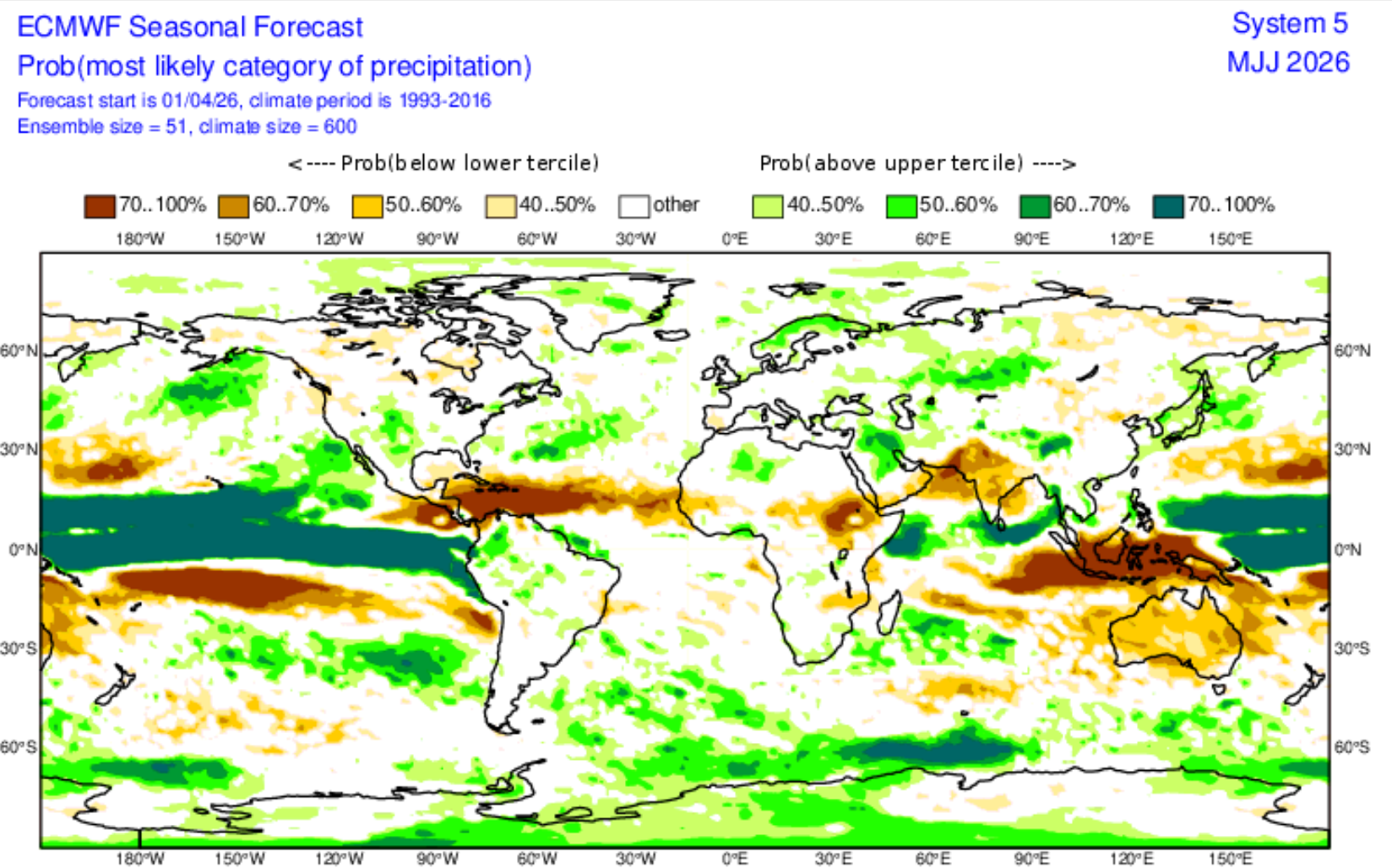
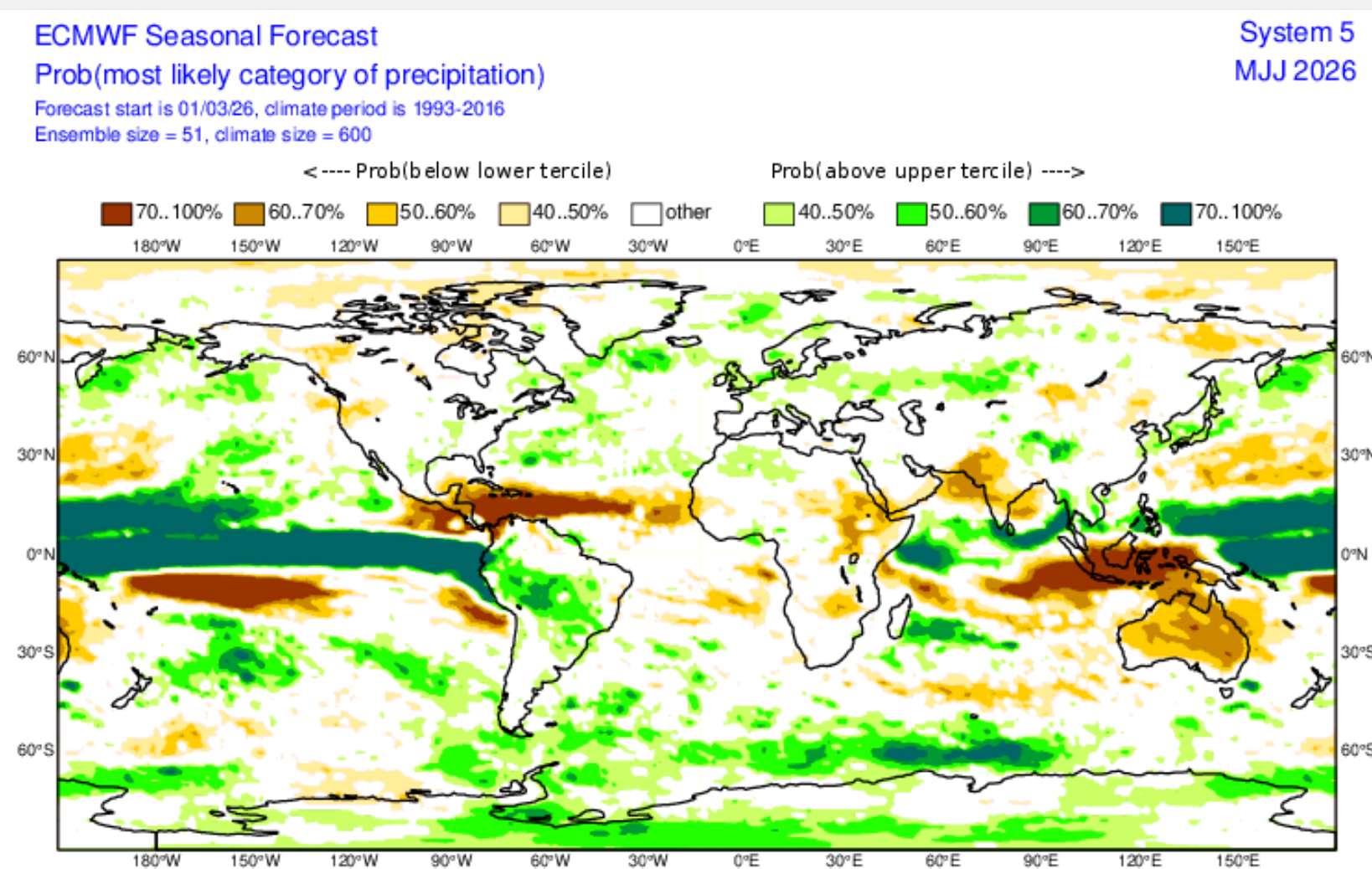
“The European seasonal model that just got released this week—that’s the May, June, July forecast—all of that green indicates precipitation anomalies that are wetter than average,” he says. “Even if they’re a little bit overdone, the situation is better than where we are right now from a historical basis.”
https://www.agweb.com/news/crops/crop-production/super-el-nino-talk-grows-what-it-means-u-s-farmers
This is the May June July forecast globally for precipitation.
This shows the June July August forecast globally
In more detail:
a super “El Nino” is nothing but a “very strong el Nino”
QUOTE STARTS
David Phillips, climatologist from Environment and Climate Change Canada, told CTVNews.ca on Tuesday that a “super” El Niño is nothing but a “very strong El Niño,” which is a significant high-pressure area that brings heat.
“It doesn’t change the weather dramatically,” Phillips said, adding that it just increases the likelihood of certain weather events like droughts and storms.
In Canada, a strong El Niño would mean a lighter winter all around the country, he said.
“The water seems to warm up in the Pacific, and it creates the conditions that will produce a strong El Niño,” Phillips said, adding that this could lead to less ice in the Great Lakes next winter which could result in more lake-effect storms.
However, Phillips cautioned that forecasting weather is challenging because climate change is a significant factor.
The extreme weather system will affect Eastern Canada the most, Moore and Phillips added, saying that it’s usually more intense for areas that tend to have warmer winters.
“It’s a bit wetter on the West Coast as well,” Moore said. “The bigger effects are global, because the sea surface temperature in the Pacific is much warmer, the whole globe is warmer.”
El Niño forming by May, potentially becoming strong by August — new ECMWF seasonal modeling.
https://www.ctvnews.ca/climate-and-environment/article/is-canada-going-to-see-a-super-el-nino-in-2026-heres-everything-you-need-to-know/
El Nino / La Nina has no effect on Arctic or sea ice
The El Nino / La Nina oscillation has no effect on the temperature in the Arctic or Antarctica or the sea ice.
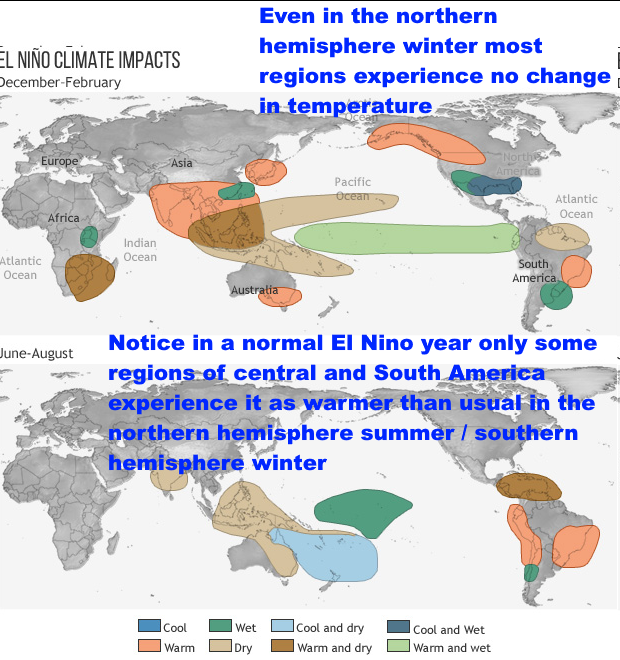
Indeed as you see from that map most areas on land don’t experience a warming. It’s mainly a change in the amount of rain / precipitation and some regions also experience cooling. See the key at the bottom.
There is warming in winter in:
- southern Asia (India / Bangladesh, Indonesia, parts of Japan etc.
- SE Africa
- Part of Brazil near the East coast
- NW US / Canada into southern Alaska
In summer in:
- parts of Eastern and Western South America
The last El Nino also had some warming in the Atlantic off Western Europe but that was an unusual anomaly on top of the normal El Nino pattern
https://debunkingdoomsday.quora.com/Yes-we-likely-get-a-strong-El-Nino-in-2023-2024-this-has-regional-effects-many-areas-of-the-world-not-affected-war
El Nino’s cause bleaching events in some corals - but in the year AFTER THE EL NINO - and La Ninas can too in different corals - and El Ninos can also benefit corals by bringing new nutrients
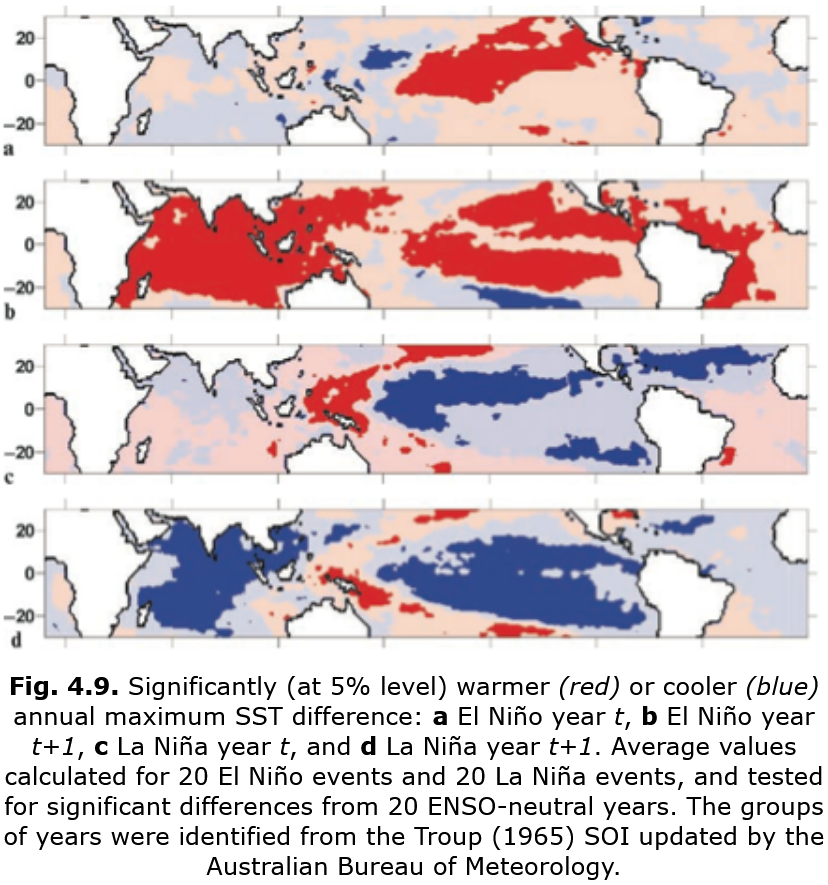
El Nino’s do cause bleaching events in some coral reefs, but usually in the year after the El Nino. La Nina’s can cause bleaching too in different coral reefs.
Here the areas shown red are significantly warmer and the areas shown blue are significantly cooler during an El Nino the year after an El Nino, during a La Nina and the year after a La Nina.
https://coralreefwatch.noaa.gov/satellite/analyses_guidance/enso_bleaching_97-99_ag_20140507.php
El Nino’s can also benefit some coral reefs by upwelling events that bring more nutrients to them.
https://www.science.org/doi/10.1126/sciadv.add5032
No warming tipping point
There is no warming tipping point.
BLOG: Earth can’t warm suddenly
— no temperature tipping point
— radiates so much extra heat with each extra 1°C of warming
— it can’t trap or absorb it all
— even with all possible feedbacks at their max
You can read it here:
https://robertinventor.substack.com/p/earth-cant-warm-suddenly-no-temperature
Corals far more resilient than we knew even a couple of years ago and wonderful new ways to help them transition
Then on saving corals, they are far more resilient than people knew even just a couple of years ago and we have also developed numerous wonderful methods to help them transition.
A warmer world is actually beneficial to corals if we get there slowly enough and so long as it is well below 3 C. At 3C it’s not the warmth, it’s the extra CO2 in the oceans that makes them uninhabitable for corals not far above 3 C and they transition to sponge reefs. Often have in the very distant geological past.
But we don’t get anywhere near that on the 1.5 C path and in the second half of this century we should have a massive flourishing of the branching corals as they recover fastest as the ocean stabiizes and we get coral reefs recovering and new reefs gradually colonizing areas of the oceans that used to be too cool for them.
On 1.5 C path (which we are pretty much on now) the corals have a boom time especially for branching corals in the warmer oceans of the second half of this century
If the oceans warm faster then they take much longer to recover but on the 1.5 C path it’s only a few tenths of degrees further warming, we can help them to transition that much and they can also adapt by themselves and the second half of the century may be a boom time for branching corals relative to the present and the compact corals also expanding but more slowly.
See my:
BLOG: South Florida branching corals rescued after 2023 heatwave and replanted and these species grow back in years to a decade
— some branching corals survived even in south
— NOT any risk of extinction
— Indeed long term the future prospects are very positive with potential for a revival / renewal as global warming slows down as the corals did in the Holocene optimum 3000 to 5000 years ago
You can read it here:
https://robertinventor.substack.com/p/florida-corals-are-not-functionally
https://ddebunked.org/d/3143-climate-change-is-exaggerating-el-nino-effects/6
El Ninos recently had bumper crop yields
The last El Nino had bumper crop yields. It registers as a warmer climate mainly because the ocean is warmer. Effects on land depend on where you are and the season. Sometimes warmer, cooler, drier, wetter and Europe is not affected at all. Many other areas are not affected.
We actually grew records amount of grain in 2022-3 and in 2023-4 which were El Nino years.
For 2023:
BLOG: Yes 2023 is the hottest year on record - as expected in a + 0.2 C phase on top of 1.2 C - also had bumper harvests - highest cereal crops on record and highest surplus on record - a warmer world can actually be better on low emissions
https://debunkingdoomsday.quora.com/Yes-2023-is-the-hottest-year-on-record-as-expected-in-a-0-2-C-phase-on-top-of-1-2-C-also-had-bumper-harvests-hig_and_increasingly_on_the_sustainable_development_path
Same also for 2023-4, while 2024-5 was similar to 2023-4 and 2025-6 is set to be another record from the solid orange line on the graphic
For all cereals the stock to use ratio is 31.4%. I.e. if we had a world shortfall of 31.4%.in one year, we could supply it with left over cereals from previous years.
Global cereal production is about to reach 3 billion tons for the first time ever. The orange and yellow lines here for production and utilization use the left axis and the gray bars for the stockpiles use the right axis.

We will have 954.6 million tons of cereals in stockpiles,
QUOTE FAO’s forecast for world cereal stocks by the close of seasons in 2026 stands at 954.6 million tonnes, pointing to an increase of 9.6 percent above opening levels and indicating record global inventories for wheat and rice. … Based on this month’s forecasts for stocks and utilization, the global cereal stocks-to-use ratio is forecast to rise from 29.6 percent in the 2024/25 season to 32.3 percent, indicating a comfortable supply level.
It is enough to feed
Using
millions of people fed =
(RICE million *3,309,999 + WHEAT million * 3,011,854 + MAIZE million *3,357,163)/(2700*365)
Calculation method here:
https://debunkingdoomsday.quora.com/FAO-food-projections-remained-high-in-the-COVID-pandemic-strong-performances-from-developing-countries-and-surplus-c
from the page:
RICE million = 219.8
WHEAT million = 348.5
MAIZE million = 386.3
((219.8×3,309,999)+(348.5×3,011,854)+(386.3×3,357,163)) /(2700*365) = 3,119 million people.
So the world has enough food in stockpiles to feed over 3 billion people for an extra year at the end of the year.
The El Nino if anything would help judged on the previous years.
For how it affects us regionally:
BLOG: Yes we likely get a strong El Nino in 2023–2024
— this has regional effects
— many areas of the world not affected
— warming is a global average
You can read it here:
https://debunkingdoomsday.quora.com/Yes-we-likely-get-a-strong-El-Nino-in-2023-2024-this-has-regional-effects-many-areas-of-the-world-not-affected-war
Never risk being unable to feed everyone
And we never risk being unable to feed everyone. The reason we have malnutrition at all is because of politics and economics, problems hard to solve but not any shortage of food.
BLOG: Yes we can feed everyone, world population is levelling off in the near future
— not true that the world is over populated and growing too fast
You can read it here:
https://debunkingdoomsday.quora.com/Yes-we-can-feed-everyone-world-population-is-levelling-off-in-the-near-future-not-true-that-the-world-is-over-populat
BLOG: ''‘We can grow enough food for everyone through to 2100 and beyond on all scenarios’''
https://debunkingdoomsday.quora.com/We-can-grow-enough-food-for-everyone-through-to-2100-and-beyond-on-all-scenarios
On our low emissions path of only another couple of tenths of a degree warming to go, maybe three tenths if we don’t quite make 1.5 C then the effects of these extra factors is far less.
BLOG: We are ahead of target for 1.5 C with the COP28 triple renewables pledge
— media and academics lag far behind what’s happening in the real world when they claim we are headed for 2.6 C
You can read it here:
https://robertinventor.substack.com/p/world-is-overachieving-for-15-c-with
And there is no warming tipping point.
BLOG: Earth can’t warm suddenly
— no temperature tipping point
— radiates so much extra heat with each extra 1°C of warming
— it can’t trap or absorb it all
— even with all possible feedbacks at their max
You can read it here:
https://robertinventor.substack.com/p/earth-cant-warm-suddenly-no-temperature