There are many dramatic stories on the internet and those are the ones that spread but we need to check them and the truth is nothing like the drama you think. If someone says that data centers will turn rural Utah into the Sahara desert - that gets shared widely. If someone says “Actually no that’s not true it’s just like an urban center” - who is going to share that? Virtually no-one.
That’s the nub of it, why we need this group, almost all of it, because of the tendency for falsely scary and falsely dramatic stories to spread more easily than the truth. And people are learning to realise this but don’t counteract for it enough yet.
I need to work this up into a proper blog post - it’s rather scattered at present and has some repetition, but this may be useful material for some of you. Combines together material from some of my data center deubnks. I’ll add sub headings tomorrow may help
First, we do need them. We are all using data centers right now. Almost everyone in the world depends on data centers
- if they have anything they have created online that they expect to see on line next time they visit the internet.
- if there is anything anyone else put online that you want to be able to find when you go online
You need a data center to host it.
Saying you don’t want data centers is like saying you don’t want the internet. There would be some things could work without data centers. Email would still work. But
- no web sites unless hosted on someone’s server at home which couldn’t cope with much traffic.
We’ve had more and more data centers for things like Google searches, Google Translate, YouTube videos. Netflix streaming. Online gaming.
We have high volumes of data we now expect to be able to download ith very little latency anywhere in the world - that needs duplicate data centers in every continent and multiple data centers per continent. Whenever you watch a YouTube video, it’s stored on a data center somewhere close enough to you to reduce the need to send data across the Atlantic or similar.
So we’ve already had to expand data centers for all those reasons.
AI is adding to the number of data centers. They also need to be a different type e.g. more graphics processors for generative AI or specialist chips for chatbots.
But the centers themselves are not new. And the US is an especially good place to build them so there are many there already. That’s because of its connectivity - connected to so many high bandwidth cables and technology companies and so on.
https://www.coresite.com/blog/top-10-u-s-data-center-markets-and-why-they-are-hot
As for AI, it can be very useful once you know how to allow for the many mistakes it makes. I use it nearly every day for the voluntary fact checking.
I used it to find some of the material about data centers such as about the Colossus near Memphis and how it’s powered. But it does make mistakes.
Data centers are small, far smaller than the stories make them out to be. The largest data center in the world is just under a square kilometer in Hohhot in inner Monglia/
https://gbc-engineers.com/news/largest-data-center-in-the-world
This is where it is, near a small village in Inner Mongolia 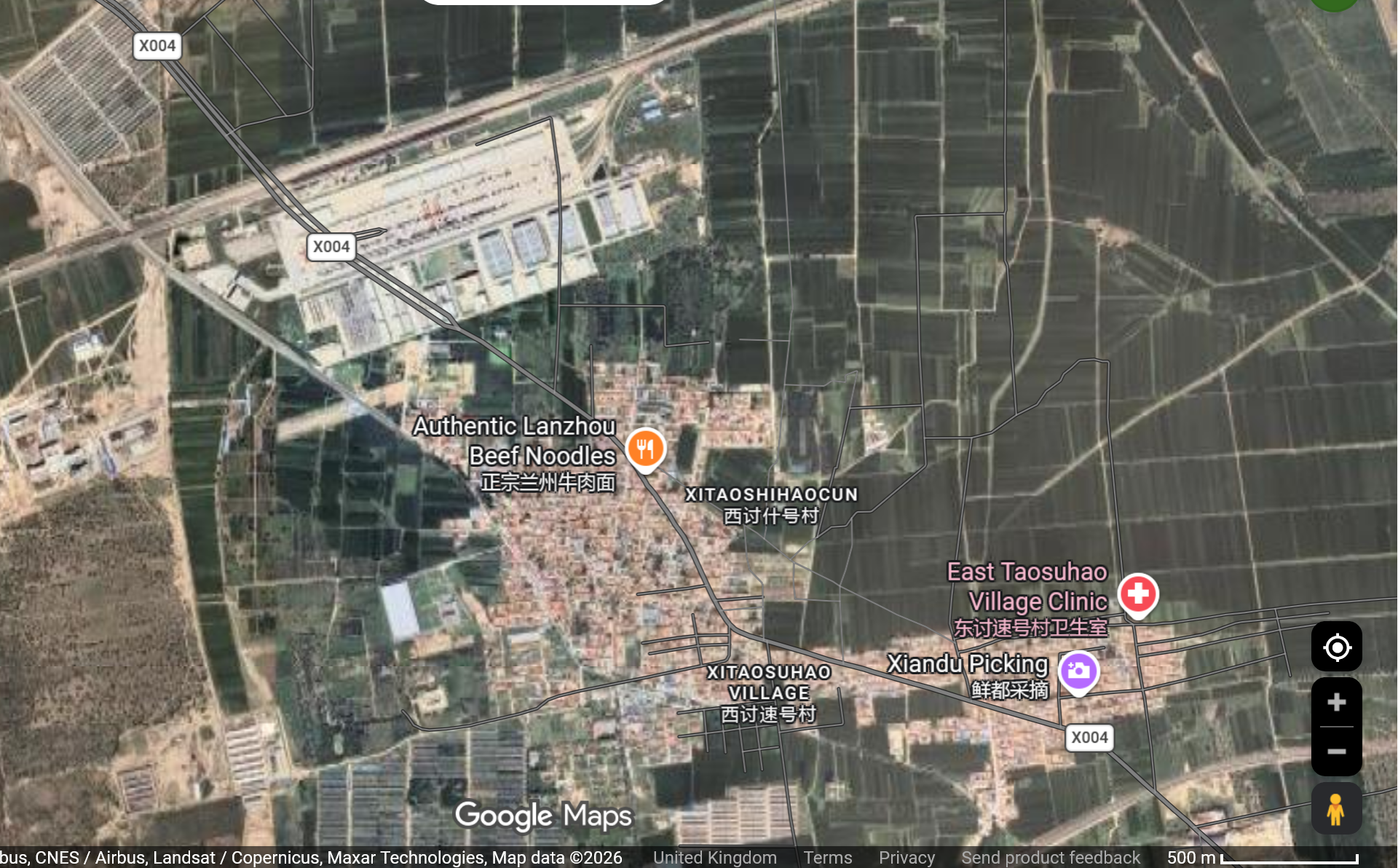
And zoom in so you can see individual houses and gardens and a corner of the center
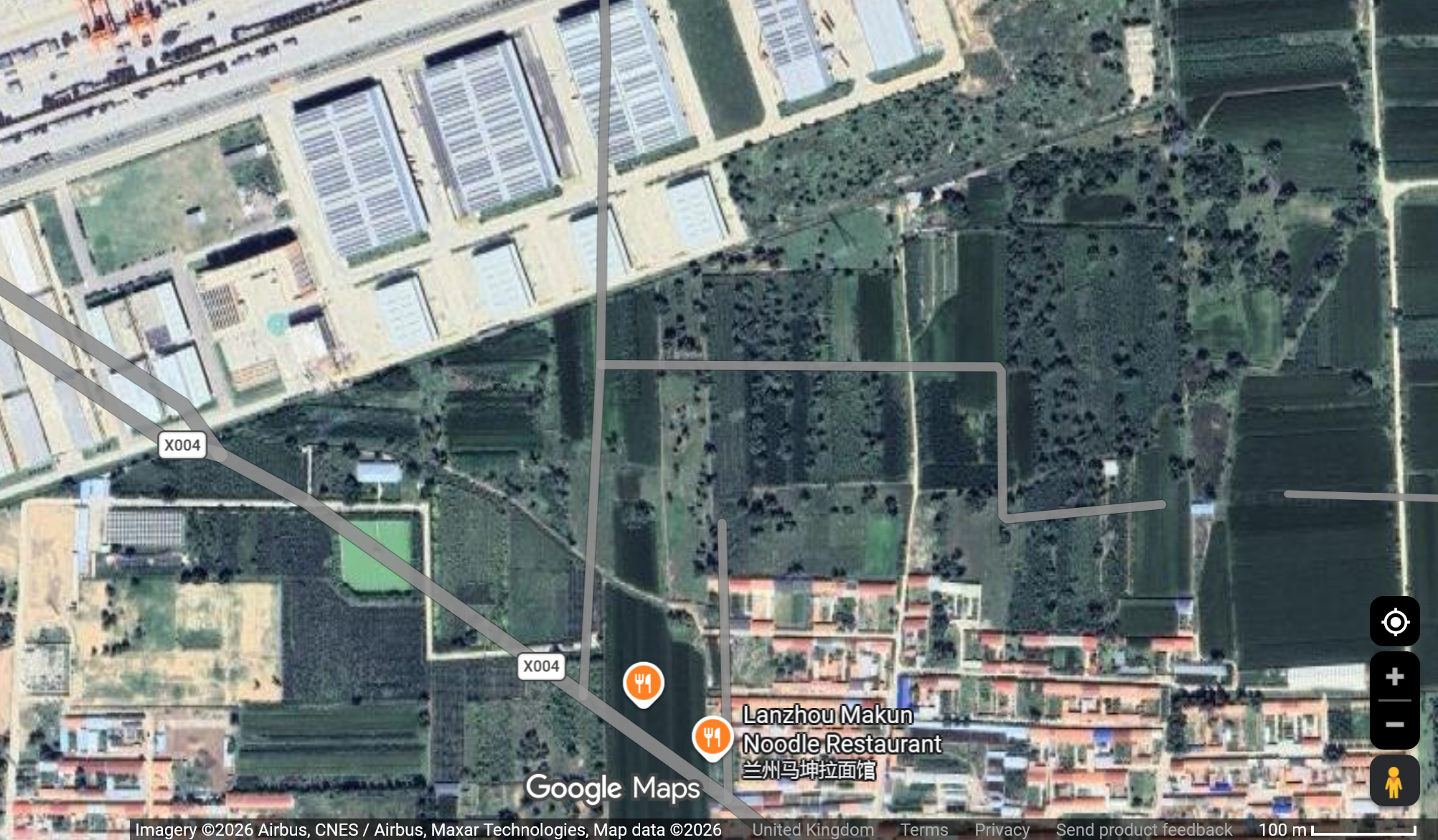
And zoom in to individual houses

And to the same scale one of the data center buildings

Google maps here
The heat island effect is similar to the effect for urban areas in city centers.
The idea it would create deserts is very misleading. City centres don’t create deserts by being warmer. They often have parks in them.
And they can be counteracted by a variety of measures. Even painting roofs white can reduce the temperature significantly in cities.
BLOG: Painting city roofs white directly counteracts a significant part of the greenhouse effect, reduces air conditioning and cools cities by reflecting heat back into space
You can read it here:
https://debunkingdoomsday.quora.com/Painting-city-roofs-white-directly-counteracts-a-significant-part-of-the-greenhouse-effect-reduces-air-conditioning-and
If you look at the data center heat islands effects paper, it ends with solutions. Some are to do with making the computation more efficient so it needs less cooling. And some are to do with desiginign the building envelope so that it reflects away more sunlight and radiates away more heat
QUOTE STARTS
Among these, passive radiative cooling has garnered particular interest. This tech-
nique engineers the optical properties of outdoor-exposed surfaces, such as building envelopes,
by incorporating high solar reflectivity to suppress solar heat gain and strong thermal emissivity
in long-wave infrared spectrum to enable radiative heat dissipation, thereby reducing the overall
thermal load on infrastructure [51–53]. Recent advancements have translated this passive cool-
ing technology into practical applications. In particular, passive radiative cooling coating based
on polymer–nanoparticle composite has been applied across various real-world scenarios, including
residential structures, urban infrastructure, and agricultural storage facilities [54]. Reported results
indicate cooling load reductions ranging from 10% to 40% after applying the coating, contingent on
site-specific factors such as surface albedo, orientation, and geographic climate conditions
https://www.researchgate.net/publication/403073048_The_data_heat_island_effect_quantifying_the_impact_of_AI_data_centers_in_a_warming_world/fulltext/69c21ebcac3812287560e46e/The-data-heat-island-effect-quantifying-the-impact-of-AI-data-centers-in-a-warming-world.pdf?origin=publication_detail&_tp=eyJjb250ZXh0Ijp7ImZpcnN0UGFnZSI6InB1YmxpY2F0aW9uRG93bmxvYWQiLCJwYWdlIjoicHVibGljYXRpb25Eb3dubG9hZCIsInByZXZpb3VzUGFnZSI6InB1YmxpY2F0aW9uIn19
The study hasn’t been peer reviewed. It doesn’t even seem to be accepted for publication. But it’s not implausible.
QUOTE STARTS
There are still big gaps in our understanding of the impacts of data centers, even as they boom in number, said Andrea Marinoni, associate professor with the Earth Observation group at the University of Cambridge, and an author of the study, which has not yet been peer-reviewed.
Marinoni and his colleagues decided to dig into one under-researched impact: the heat they release through their energy-intensive processes, including computation and powering cooling systems.
https://edition.cnn.com/2026/03/30/climate/data-centers-are-having-an-underrported
This is about city heat island effects and things you can do about them:
QUOTE STARTS
Studies estimate that heat islands increase daytime temperatures in urban areas in the United States by about 1°F to 7°F and nighttime temperatures by 2°F to 5°F. In general, cities with the largest and densest populations experience the greatest temperature differences. In fact, it’s estimated that highly developed urban areas can experience mid-afternoon temperatures 15°F to 20°F higher than surrounding vegetated areas.
Even within a city, some areas are hotter than others. Neighborhoods with more heat-absorbing buildings and pavement, and with fewer cooling green spaces, have the most elevated temperatures. Downtown and industrial areas tend to be hotter than urban parks and less densely populated residential areas.
…
There are several measures cities can take to reduce the heat island effect. Increasing tree cover and vegetation is one promising strategy. Trees reduce local temperatures by providing shade and increasing evapotranspiration (as trees release water into the atmosphere from their leaves, the surrounding air is cooled). Another option is to install reflective coatings on roofs and pavement that absorb less heat than traditional building materials. Cities can also implement zoning practices that vary the height of new buildings to increase airflow. Moreover, cities can reduce the amount of heat generated by human activity by investing in more energy-efficient buildings and manufacturing facilities, as well as reducing car traffic.
While these remain open questions, the good news is that addressing heat islands can feasibly achieve temperature reductions within cities of several degrees Celsius. While individual localities oftentimes do not have the power to make a meaningful impact on global temperature rise driven by climate change, they do have the capability to mitigate higher temperatures caused by urban heat islands. Theoretically, mitigating urban heat islands is relatively attainable as it requires unilateral actions by individual cities to change urban design decisions. Furthermore, many heat island mitigation strategies make the urban environment healthier and more livable in other ways. Planting trees, for example, can lead to improved air quality, enhanced stormwater management, reduced noise, increased wildlife habitat, and more beautiful cities.
https://www.rff.org/publications/explainers/urban-heat-islands-101/
The impact of data centers generally is small. They use water for cooling if it’s available but don’t need to use any water, they can recycle it if the conditions require that. The electricity use can be significant for a small community so they often need their own power plants but very small compared to global electricity use and will eventually all be renewables.
They aren’t polluting themselves.
Some of them use natural gas for power - the least polluting of the fossil fuels in terms of the emissions from burning the gas. After all many people use natural gas for their gas stoves at home. So they can’t be very polluting and if they replace fossil fuel from coal or wood they generally reduce pollution significantly -they don’t have sulfur content, hardly anything and they greatly reduce particulates - very little smoke. And generally the aim is to switch to renewables when they can, but they use portable gas power plants to get them up and running quickly.
So datacenters have to be built somewhere and activists exaggerate how large they are and of course those tweets that scared you near certainly are stored on some datacenter somewhere - most likely multiple copies in different continents. Bluesky is hosted on Personal Data Servers which are many of them virtual servers in the “cloud” on various cloud platforms like DigitalOcean, which means you don’t know which data server they are physically located on.
On the Utah data center:
While data centers get a bad reputation, Morris said in his presentation, this one will generate all of its own energy and its water use will be minimal with a closed-loop system.
https://www.newsfromthestates.com/article/massive-box-elder-county-data-center-could-increase-utahs-carbon-emissions-50
In Millard County, both Joule and Creekstone Energy intend to build their own massive facilities, powered by natural gas. Mark McDougal, a managing partner of Joule’s campus, said that burning natural gas is efficient and a proven technology that can run around the clock.
“We are so excited for other alternative energy sources like geothermal and solar and wind and someday, maybe even nuclear,” McDougal said. “But we can’t wait for that.”
https://grist.org/business/ai-utah-data-center-boom-fossil-fuels-gas/
In November, the federal government removed northern Utah from its list of regions out of compliance for wintertime inversion pollution after more than a decade, thanks to state efforts like banning wood burning on poor air quality days combined with stricter federal regulations on vehicles and fuel. But it continues to struggle with meeting national limits for ozone smog.
The new data centers coming online, with their diesel and natural gas generators, could bump the state right back out of compliance, environmental advocates say. “They’re eating into all of the progress we’ve made to reduce emissions from other sources,” said Mitchell from Utah Clean Energy.
State regulators said they’re not just concerned about temporary diesel generators and year-round natural gas generators taking a bite against air quality gains in recent years.#
https://grist.org/business/ai-utah-data-center-boom-fossil-fuels-gas/
https://ddebunked.org/d/3858-concerned-about-the-large-data-center-going-up-in-utah
The size is just the campus. The data center would be far smaller. It’s natural gas but natural gas is the easiest type of power station to add carbon capture to. Not likely under Trump but a future president who returns to the Paris Agreement would be likely to require the natural gas power stations to add carbon capture. It would use closed system for water so it’s not a water concern. And the total energy use for data centers though higher as a % in the US is about 0.5% of total electricity globally.
QUOTE STARTS
Electricity is just a subset of total energy use, so data centres consume less than 0.5% of final energy, and AI less than 0.2%. That’s useful to keep in mind: the AI debate is an electricity one, not an energy one.
…
Most of the growth in data centre demand will come from AI-focused facilities. In the IEA’s base scenario, data centres grow to 3% of global electricity in 2030. AI centres then use about the same amount as non-AI ones.
https://hannahritchie.substack.com/p/ai-electricity-2025
Meanwhile by 2030 the global electricity is rapidly transitioning to renewables.
BLOG: We are ahead of target for 1.5 C with the COP28 triple renewables pledge
— media and academics lag far behind what’s happening in the real world when they claim we are headed for 2.6 C
You can read it here:
https://robertinventor.substack.com/p/world-is-overachieving-for-15-c-with
In more detail:
There is no way that a data center spans 40,000 acres. That’s 161 square kilometers.
With the natural gas - the plan doesn’t seem to use Carbon Capture and Storage - but that’s not too surprising under Trump. It is much easier to add CCS to natural gas than to coal so that’s something can be done later or they can transition to renewables.
About how it will be closed system for water use (water is used for cooling and with a closed system, the evaporated water is collected and reused)
QUOTE STARTS
While data centers get a bad reputation, Morris said in his presentation, this one will generate all of its own energy and its water use will be minimal with a closed-loop system.
https://www.newsfromthestates.com/article/massive-box-elder-county-data-center-could-increase-utahs-carbon-emissions-50
This is about how they’d like to use renewables but natural gas is an efficient and proven short term solution
This is for other data centers in Utah - the state has numerous data centers being built there.
QUOTE STARTS
In Millard County, both Joule and Creekstone Energy intend to build their own massive facilities, powered by natural gas. Mark McDougal, a managing partner of Joule’s campus, said that burning natural gas is efficient and a proven technology that can run around the clock.
“We are so excited for other alternative energy sources like geothermal and solar and wind and someday, maybe even nuclear,” McDougal said. “But we can’t wait for that.”
https://grist.org/business/ai-utah-data-center-boom-fossil-fuels-gas/
I suppose it’s a natural state to build data centers with vast rural areas with not many people living there.
Local concern is partly because of the potential of smog from burning natural gas
QUOTE STARTS
In November, the federal government removed northern Utah from its list of regions out of compliance for wintertime inversion pollution after more than a decade, thanks to state efforts like banning wood burning on poor air quality days combined with stricter federal regulations on vehicles and fuel. But it continues to struggle with meeting national limits for ozone smog.
The new data centers coming online, with their diesel and natural gas generators, could bump the state right back out of compliance, environmental advocates say. “They’re eating into all of the progress we’ve made to reduce emissions from other sources,” said Mitchell from Utah Clean Energy.
State regulators said they’re not just concerned about temporary diesel generators and year-round natural gas generators taking a bite against air quality gains in recent years.#
https://grist.org/business/ai-utah-data-center-boom-fossil-fuels-gas/
Natural gas does produce some smog but it’s by far the cleanest of all the fossil fuels, far cleaner than coal or oil or diesel or burning wood. It consists mainly of methane and burns to make carbon dioxide and water. But it does produce some other products like nitrogen oxides.
This is from the Natural Gas industry but attempts to present things in an unbiased way.
I can find a better cite but this is accurate. Natural gas produces almost no particulates and much lower levels of nitrogen oxides and has virtually no sulfur content.
It’s far better in terms of smog than any other form of fossil fuel or wood. Though not as good as renewables or nuclear which can’t produce any.
QUOTE
The use of natural gas does not contribute significantly to smog formation, as it emits low levels of nitrogen oxides, and virtually no particulate matter. For this reason, it can be used to help combat smog formation in those areas where ground level air quality is poor.
https://naturalgas.org/environment/naturalgas/
So, as you expect, those opposed hype it up a bit.
Data centers generally will have only a minor effect on global warming, a fraction of the effect of electricity generation and as the electrical grid goes to net zero they will become net zero too. A custom generator like this of natural gas can be replaced by renewables later or carbon capture and storage. It would contribute slightly to smog because it is adding a new power plant not replacing existing fossil fuel power plants but because natural gas is so clean the effects are likely to be minor.
Memphis TN data center is powered by natural gas turbines. So it can’t be diesel fumes from its power station. The power station is a former gas power plant six miles away from it.
These are the cleanest form of fossil fuel power, far cleaner than diesel or coal. Mississippi regulators gave xAI approval to run them for up to 12 months without a permit. The power station is NOT illegal. It is legally running without a permit while they seek permits.
QUOTE STARTS
In July 2025, xAI has purchased a former gas power plant, previously owned by Duke Energy, close to the site of its new Colossus 2 data center in Memphis, Tennessee. The plant is located on Stanton Road in South Haven, across the state border from Memphis in Mississippi, and six miles from Tulane Road, where the new data center will be built.[9][10] Shortly after, Mississippi regulators granted xAI temporary approval to run gas turbines there for up to 12 months without a permit. To transport and manage power generated by the Mississippi power plant, xAI is building infrastructure near Colossus 2.
https://www.gem.wiki/Colossus_2_power_station
The reason xAI chose Memphis is because they were looking for premises for sale anywhere in the USA large enough for the new data center. They found one in Memphis the former Electrolux factory
QUOTE STARTS
It all came down to timing. Musk says he was able to get xAI up and running within 122 days because he used an abandoned building instead of taking the time to start from the ground up.
“We needed a building. Well, we can’t build a building, so we must use an existing building,” Musk said.
…
“So we found an Electrolux factory in Memphis. That’s why it is in Memphis. Home of Elvis,” said Musk. “It was a very nice factory, for whatever reason, Electrolux left. That gave us shelter for the computers.”
…
On Tuesday, the Memphis City Council approved selling additional land to xAI, where the company will use the land to build a water recycling facility to cool its Colossus supercomputer and two nearby industries.
…
xAI will purchase the 13 acres of city-owned land near the company’s current site for $820,000, where they will build an $80 million facility used to recycle wastewater from a nearby water treatment plant.
https://wreg.com/news/local/xai-memphis/elon-musk-finally-reveals-why-memphis-for-xai-supercomputer/
xAI did install some unpermited turbines which it removed when it was told the NAACP intended to sue under the Clean Air act and got permits for the remaining ones.
xAI removed its unpermitted turbines at the Colossus 1 data center after SELC, on behalf of the NAACP, sent a notice of intent to sue under the Clean Air Act. The company obtained permits for its remaining 15 turbines.
https://www.selc.org/news/xai-built-an-illegal-power-plant-to-power-its-data-center/
We have had AI for decades. Better term machine learning. Used for:
- google translate
- auto complete
- ability of Google images to find images that match a description
- medical imaging uses it to enhance things
and numerous other ways.
Of those I think google translate is closest to chatbots.
What most people mean by AI today is chatbots that are able to carry out conversations that can be indistinguishable from conversations with a human - at least for a while and especially if you are new to chatbots and don’t spot certain tell tales.
But there is no understanding. It’s just extruding human-speech-resembling patterns.
Just like Google Translate has no understanding of any languges, there’s a very close parallel.
See my:
BLOG: Chatbots are “text extruding machines” (Emily Bender)
— work statistically
— like predictive text
— or Google Translate
— with no attempt to attach meanings or logical structures
You can read it here:
https://robertinventor.substack.com/p/chatbots-are-text-extruding-machines
There is no reasoning or memory either. And it can’t even do error free arithmetic without adding in a calculator. Should be the easiest thing to understand for a computer program if there was any understanding. It should never make mistakes. But there is no understanding.
And try to add in reasoning, and meaning, you can, but then it immediately loses its ability to be human-like and to extrude text that we assign so much meaning to.
It’s not assigning any meaning from its side. It’s just word patterns. There is no intention. There is no “it” really to assign meaning either.
It’s hated by many people because of confusing and misleading things said about it. It has niche roles but surprising ones.
For example Claude AI is very good at finding bugs in software, and especially security issues. It has found bugs that humans never noticed in decades of working with the code.
And Chat GPT 5.3 has an unexpected ability to find new proofs of unsolved problems in maths. Many mathematicians have been able to solve problems that nobody could see how to prove for decades. Not all of them. Some problems in maths yield to these extruded pattern creators - they extrude a proof of a theorem. By blending together proofs from other published theorems on the internet. They can’t reason, can’t do simple arithmetic in an error free way - yet they can sometimes print out a proof of a theorem that people haven’t noticed for decades that is surprisingly simple.
Their proofs aren’t error free. As with everything else they do it can make dumb mistakes. But there is a way of checking some mathematical proofs by coding them in a formal computer language called lean. If it compiles in lean its a correct proof. Some of their proofs have been fixed by human mathematicians and shown to be true in this way or in other ways.
There seems to be a limit - it is only able to solve some problems but the ones it solved have brought new ideas and techniques to maths.
They also do these search results in Google
- that are often quite good now
- sadly sometimes they seem convincing but are VERY WRONG.
As a simple example search for Vermont is at close to 100% renewables.
It will tell you that it is true. But it won’t explain that this is the electricity produced in state in Vermont. 73% of its electricity is imported though it aims to reach 100% renewables in 2030 / 2035.
It’s got many things wrong for me even today. That was one of them.
So - that’s an issue with them and there are many others. Misinformation. Confusing people.
On rare occasions chatbot mistakes or unskillful responses have been a contributing factor in suicide, accidental harm or even murder.
They certainly need to be regulated. And people need to know to watch out for their mistakes.
These are very major issues for someone who died or has a friend or colleague who died as a result however rare it is relative to the population. We shouldn’t minimize this in any way.
So there are real and major issues. But often it’s not these issues that bother people and they worry about other things that are more like science fiction. So it’s about finding out what’s real and what’s fantasy here.
Chatbots are here to stay and so we need the data centers for them.
And they will need far less electricity than most people project because they are becoming more efficient.
I go into that and other details here:
BLOG: How Chatbots are being improved to use energy more efficiently
— stories that claim they will use too much energy to be useful in the future miss out these details
You can read it here:
https://doomsdaydebunked.miraheze.org/wiki/How_Chatbots_are_being_improved_to_use_energy_more_efficiently_-_stories_that_claim_they_will_use_too_much_energy_to_be_useful_in_the_future_miss_out_these_details
Hannah Ritchie has several posts about ai data centers may help.
This is her latest
https://hannahritchie.substack.com/p/ai-electricity-2025