Nothing to be scared of. Just another falsely scary video by Anton Petrov He used to do excellent astronomy / cosmology videos but then he gradually changed to clickbait scary titles and fantasy endings that tell people to be scared of harmless cosmological things. I am not sure, he has to know that the fantasy endings are false, maybe it’s some kind of a dry humour? Anyway you can safely block him and ignore his videos.
The main part of this video miss-sumarizes the May 15 research section on ozone. It ACTUALLY SAID that the effects of ozone of all rocket launches by 2029 will be tiny (a 0.02% reduction) and only a tenth of that tiny amount is from megaconstellations.
Then at the end he says FALSELY that without the ozone layer we’d all die. That’s what scares the people we help. He seems to feel he has to make up a FALSE way that something will kill us all in order to make the video more interesting. Not just this video. In many videos it’s a common pattern. He never used to do that in his earliest videos.
We have had many big ozone holes over Antarctica and the Arctic region and we have high UV in Andes / Tibet / Nepal / Everest base camp - need to take more precautions but don’t die
We had big ozone holes over Antarctica now healed and obviously life in Antarctica wasn’t affected. The penguins are still there and there wasn’t any moratorium on Antarctic exploration. We’ve had big ozone holes over the Arctic area too in areas where people live like Greenland and Siberia. And significant reductions even in the tropics but not enough to need extra protection.
The ozone layer protects against UV and there’s much more UV at high altitudes in the Andes and places like Tibet and Nepal, again there’s lots of life there as well as humans that live at high altitude. And there’s more UV in Antarctica anyway than at the same altitude in other parts of the world.
Then, every time the magnetic field reverses which happens several times every million years the ozone layer is greatly depleted and we don’t die and all the species around us have survived that numerous times. If the ozone layer was greatly depleted we’d have to use sun block cream and UV blocking glasses to protect us from a higher risk of skin cancer and of cataracts later in life.
I go into that here
BLOG: Debunked: No, we are NOT headed for a magnetic pole shift in less than centuries and it won’t do much whenever it happens
— our descendants wlll need slightly better protected satellites and more sun block cream on sunny days during the reversal
You can read it here:
https://debunkingdoomsday.quora.com/Debunked-No-we-are-NOT-headed-for-a-magnetic-pole-shift-in-less-than-centuries-and-it-won-t-do-much-whenever-it-happen
It’s similar for Everest base camp. Because of the high altitude tourists should wear a wide brimmed hat and use sunblock cream and UV blocking glasses.
QUOTE STARTS
Sun Hat / Cap
It protects your face, ears, and neck from strong UV rays at high altitudes. A wide-brimmed sun hat is best for daytime hiking. It helps to prevent sunburn and heat exhaustion. Lightweight and foldable hat designs are great for trekking.
UV-protected snow goggles or glacier sunglasses are indispensable to protect your eyes from snow blindness caused by intense sunlight reflecting off snow.
The UV-protected sunglasses and high-SPF sunscreen are also crucial to shield your eyes and skin from strong ultraviolet rays at high altitude
https://econepaltrekkers.com/what-to-pack-for-everest-base-camp-trek/
That’s similar to what we’d have to do in the middle of a magnetic field reversal. Not that you’d die directly of the UV but increased risk of sun burn, skin cancer and cataracts.
No effect at all from rocket launches and megaconstellations - only 0.02% reduction
But nothing like that from these rocket launches and megaconstellations. No effect at all.
The May 2026 study into the effects on climate of the rocket launches including megaconstellations found that there is an effect of launches on the ozone layer but it’s small compared to the ozone depleting gases regulated by the Montreal accord.
This is the May 15 study:
QUOTE STARTS
The team also looked at the impact that megaconstellations are having on the overlying ozone layer that protects humanity from harmful ultraviolet radiation from the Sun. Satellite launches can also release chemicals such as chlorine into the atmosphere that can degrade ozone by reacting directly with it. Both launches and re-entries also produce tiny particles that provide reaction surfaces that also speed up ozone depletion reactions.
They found that based on current trends, the impact on the ozone layer from megaconstellation launches will be small, as kerosene-fuelled rockets do not produce chlorine and very few megaconstellations have so far been launched with rockets that emit chlorine. By 2029, collectively all rocket launches will only deplete global ozone by 0.02% compared to 2% due to the ozone-depleting substances that are regulated by the Montreal Protocol. Megaconstellation missions account for less than a tenth of the ozone loss from all 2029 missions.
https://www.ucl.ac.uk/news/2026/may/satellite-launch-pollution-rapidly-accumulating-upper-atmosphere
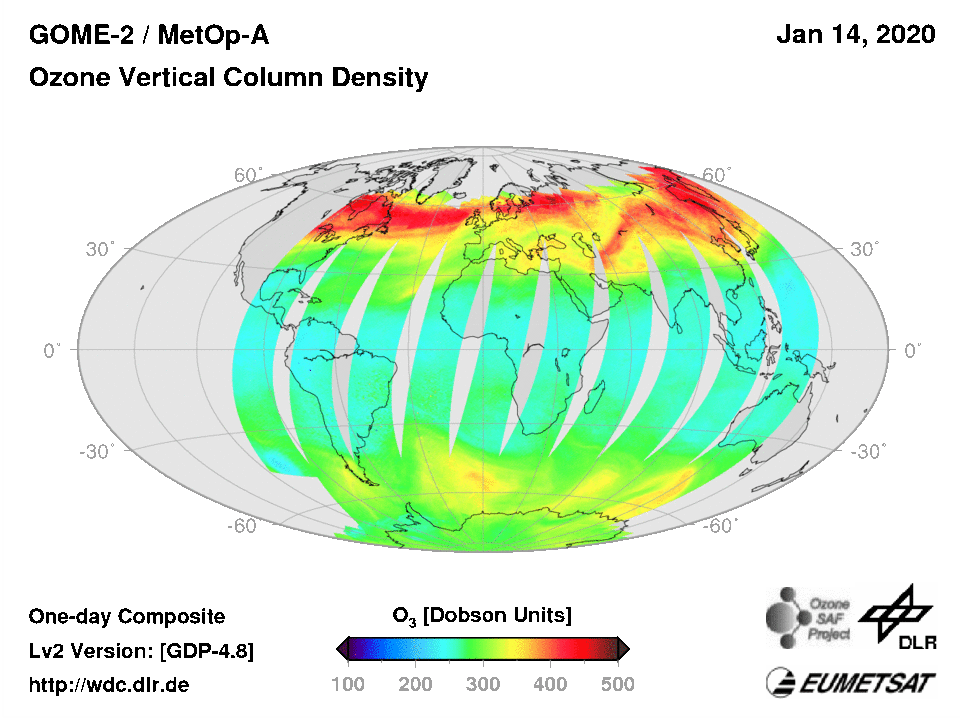
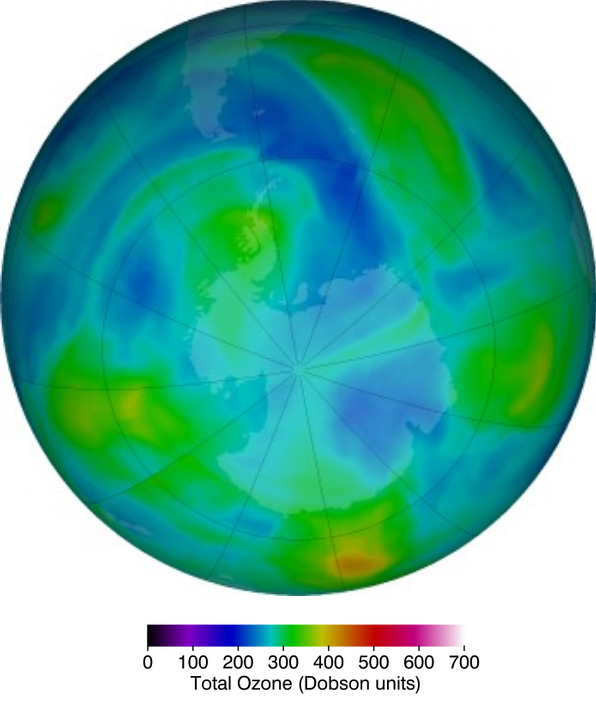
Ozone concentrations vary hugely in the atmosphere - and then ozone holes reduce the levels even more - varies from over 500 units to 100 or less in deep oxone holes
The amount of ozone in the atmosphere varies hugely. Here red means lots of ozone
https://uk-air.defra.gov.uk/research/ozone-uv/gome
Same here
https://ozonewatch.gsfc.nasa.gov/
This was a rare hole over the Arctic region in 2020 where bright red means less ozone
QUOTE STARTS
Abundant amounts of polar stratospheric clouds throughout the dark winter months created a much bigger reservoir of reactive CFC byproducts than usual. As the Sun returned through late February and early March, ozone destruction occurred rapidly.
…
According to NOAA satellite observations, the lowest ozone values over the Arctic in March were on the order of 200 Dobson Units (DU) according to NOAA satellite analysis. A NASA analysis found similarly low values. That’s significant for the Arctic, but far less severe than the hole that forms each spring over Antarctica. There, experts classify any value below 220 DU to be part of the ozone hole, and the area meeting that definition reaches 21million square kilometers on average. In places, ozone levels can drop below 100 DU.
Before Montreal accord, ozone was depleting 2% per decade
To put that in context during the period before the Montreal accord the ozone depleting gases depleted the ozone layer by 2% per decade on average between 60 degrees South and 60 Degrees North - much more in the polar regions.
QUOTE
The depletion of stratospheric ozone over the past three decades has been substantial. Between 60°S and 60°N it averaged about 2%/decade - 0.02% is nothing
https://archive.ipcc.ch/ipccreports/tar/wg1/138.htm
Compared to that a 0.02% reduction is nothing. It could be more significant if megaconstellations used rocket fuel that includes chlorine.
The May 15 paper includes the effects of aluminium oxides.
The main effect it found is a cooling effect and a kind of unintended small scale geoengineering to cool the climate.
We find that global stratospheric ozone depletion from all mission types is relatively small compared to surface sources and megaconstellation missions only account for about one-tenth of this depletion. This is because rockets launching megaconstellations almost all use kerosene, a large source of black carbon or soot particles, but not of chemicals such as chlorine that directly destroy ozone. Soot from rockets absorbs sunlight, warming the upper layers of the atmosphere and decreasing the amount of sunlight reaching Earth’s lower atmosphere, causing it to cool. Megaconstellation missions are responsible for about half of this climate effect. In this regard, rockets launching megaconstellations and other missions are like small-scale stratospheric aerosol injection experiments without forethought for potential unintended consequences.
https://agupubs.onlinelibrary.wiley.com/doi/10.1029/2025EF007229
Some rocket launches may use fuel with chlorine - if it is an issue it would be added to the Montreal Accord like HFCs
There is some potential for rockets that use fuel with chlorine in them - some Amazon launches may as well as the Chinese megaconstellations.
QUOTE STARTS
The deployment of more megaconstellations is already underway, some using fuels that emit chlorine. Amazon is developing its own internet satellite constellation known as Leo, and China is likewise developing its Guowang constellation. Together, these could place tens of thousands of new satellites in orbit, likely requiring dozens or hundreds of launches.
The potential impact of these is uncertain. Amazon-Leo satellites will be launched into orbit using Blue Origin rockets propelled with liquid hydrogen or liquid methane fuel. Neither release chlorine, but some Amazon-Leo contracts are with launch providers that use chlorine-containing solid rockets. Which rockets China plans to use is not clear, but they have so far relied on chlorine-containing solid rockets.
https://www.ucl.ac.uk/news/2026/may/satellite-launch-pollution-rapidly-accumulating-upper-atmosphere
So it is something to keep an eye on and not impossible that we do need to expand the Montreal accord to include rocket launches that use fuel that contains chlorine. It’s already been expanded to include HFCs. There would be no need for a new treaty as we already have the Montreal accord.
Wooden satellite is interesting but would need research to see if it is better for our atmosphere on re-entry
The wooden satellite is interesting. But not at all clear that it is better for the environment when it burns up. This is an example post suggesting it is:
QUOTE STARTS
The LignoSat probe, composed of magnolia wood, is scheduled to travel into outer space later this year. The choice of wood was not taken lightly, with the material first having been tested in laboratories in which the conditions of space had been recreated. Following these, samples of magnolia wood were sent to the International Space Station, undergoing exposure tests for nearly one year before returning to Earth.
The results of these tests showed that the magnolia wood had been subjected to very little damage following exposure in space. Astounded by these results, the researchers in Kyoto plan to monitor the deformation of magnolia wood during the operation of the LignoSat in space later this year - where it is expected to operate for at least six months.
Where the LignoSat proves capable of successfully operating in space, the ramifications for environmentally-friendly space activity are considerable. All over the world - and in the UK in particular - space activity is increasing, with an estimated 2,000 satellites set to be launched into orbit annually in the coming years. The more of these satellites which can be constructed from magnolia wood, the better. Upon re-entry into the atmosphere, the LignoSat will produce nothing more than a fine spray of biodegradable ash as it burns up - harmless to the environment. As such, the LignoSat stands as a great example of how thinking outside of the box can lead to an innovative solution to the environmental impact of space activity.
https://www.marks-clerk.com/insights/latest-insights/102j0wr-the-lignosat-is-fantastic-woodent-you-agree/
But that’s not based on any study of the environmental effects. I’m not convinced. The issue is that wood when burned - at the very high temperatures of re-entry - it will be mainly water and CO2 and very little soot - but there’s also a nitrogen content in wood. The nitrogen burns into nitrogen oxides and those can harm the ozone layer.
Interestingly the Chinese at one point used wooden heat shields for satellites that re-entered with spy satellite films. They were made of white oak wood. Seems implausible but it worked. The wood burnt leaving a layer of soot which protected the satellite as one layer after another burnt during re-entry.
QUOTE STARTRS
When it came to the heat shield, Chinese scientists weren’t keen on using ablatives like the Americans and Soviets were using at the time. Ablative heat shields use a chemical material that burns away with reentry, dissipating the heat. They’re effective but heavy, and China wasn’t quite in the right place technologically at the time to develop the low-density foam tiles the space shuttle would eventually use.
So when it came to reentry, Chinese scientists looks for the simple solution, and that turned out to be wood. Specifically, white oak wood. It’s light, doesn’t catch fire too easily, and can effectively protect a payload from heat.
The FSW satellites used a 5.9-inch thick heat shield made of oak. During reentry, friction caused the wood to burn and char, leaving behind a layer of charcoal. That charcoal was blown away in the wind as the satellite fell, exposing more oak, which burned and turned into charcoal. It’s a repeating process that ultimately allowed very little heat to get through to the spacecraft; both the wood and the charcoal are great insulators. It was a light and elegant solution to the reentry problem.
Though the FSW series began in the mid 1960s, it only made its first flight a decade later. Between 1975 and 2005, 23 successful FSW satellites flew as the program evolved. Originally intended to work out the details of recovering satellites from orbit before taking on manned missions, the program focussed on reconnaissance photography when the manned flight goal was cancelled. In the 1980s, the FSW missions started looking into biological and life sciences as well as improved materials and designs for the nation’s ever evolving space program.
https://vintagespace.wordpress.com/2016/12/05/can-a-wood-heat-shield-really-work/
So in principle we could have wooden heat shields too. But we’d need to check the effects if we did this in large numbers.
It’s an interesting technology and something to explore but it would need proper research to find out if magnolia wood satellites or white oak heat shields would be better or worse for the ozone layer.
Previous very mistaken scary posts by Anton Peskov - a shame as he’s an engaging and enthusiastic presenter and could do really good videos
On Anton Petrov, it’s such a shame as he is an excellent and engaging presenter.
But his research is careless now, probably because he does so many videos and doesn’t seem to spend enough time on the research, and then he often adds these throwaway remarks at the end “And BTW we will all die” which are just made up or absurd extrapolations which he can’t mean seriously.
With his background, he has to know enough to know these exaggerated things he says at the end are not true, and presumably think it adds to the interest of the video. Maybe intended as dry humour or something? Impossible to know as he doesn’t say why he does it.
We have had to debunk his videos for scared people many times in the Facebook group.
Examples of FALSELY SCARY STORIES we had to debunk in the past from Anton Petrov:
This is a copy of my reply here at top level so we can share it as a debunk..
https://ddebunked.org/d/4102-thoughts-on-spacex-destroying-the-ozone-im-worried/2